Tuesday, November 14, 2006

The Age article


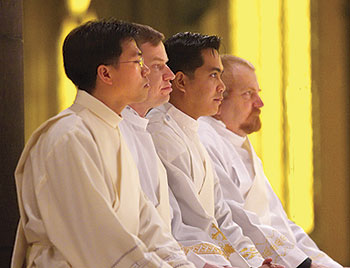
Poverty, chastity and obedience: it's an ascetic career path, and one fewer and fewer are choosing. Liz Porter meets some of the men who have traded a conventional life for the Catholic priesthood.

At 9.30pm on a Friday night, a group of young men cruise up and down Carlton's Lygon Street, revving car engines and chatting up girls. Two hundred metres away, in the historic bluestone chapel at the heart of Drummond Street's Corpus Christi Seminary, another group of young men kneel silently at evening prayer.

Read the whole article

Monday, October 23, 2006

Searching for Servants

Sunday Homily
Our Lady of Mt. Carmel
October 22, 2006

Ambition

Can you still remember your ambition when you’re still a young boy or girl? When I was in primary school in the Philippines I remember our teachers always asked us students what we wanted to be when we grow up. I was unsure yet at that time what I wanted to be but I can still clearly remember some of my classmates’ ambitions – teacher, doctor, scientist, farmer, nurse, soldier, ramp model, astronaut and someone even wanted to become the President of the Philippines! Well, he didn’t become one!

As a young boy my first ambition was to become a soldier, not only because my father was in a military but because Rambo was famous at that time. I didn’t a become Rambo, yet. God has a different plan. I become a soldier of Christ.

Selfish Act

In the Gospel today, we heard about the ambition of the two disciples of Jesus, James and John, they are brothers and their personal ambition was to be the greatest among the other ten disciples. They said to Jesus, “Allow us to sit one at your right hand and the other at your left in your glory.” In other words, James and John, wanted to be famous among all, they aspired to be elevated in higher rank in the group. They openly express to Jesus their desire to be placed in a special position, to have an exemplary power and influence in the new community.

But James and John aren't alone in their misunderstanding: the rest of the Twelve become indignant, fearing that the best seats have been taken. So James and John not only speak of human side of the apostles but their special favour to Jesus also speaks of our inner desire as human persons. We too sometimes or oftentimes wanted to receive special treatment from other people. Sometimes deep within our being lie a longing to be famous, influential and popular, a desire to stand out among the crowd and let people know how special we are.

However, the Gospel tells us that if we want to be a follower of Christ this should not be the case. Jesus said to James and John, and to other disciples, “You do not know what you are asking.” To be a Christian is to be like Christ “who came into this world not to be served but to be served.”

Servus Servorum Dei

The motto of the late Pope John Paul II is a Latin phrase “Servus Servorum Dei” which means in English, “Servant of the Servants of God.” The late Pope considered himself as a humble servant of all the other servants of God.

Jesus is Servant, he came to serve us and if we desire to follow him we first allow him to serve us and then we serve others. This being servant will cause suffering of various kinds, which Jesus drank, but there is a future Kingdom of God. This Kingdom will be like the Land of Promise for the exiled people of Israel. James and John ask Jesus if they could be granted a special place in this kingdom. To these friends, Jesus offers them, not the thrones of glory, power, and distance, but the royal dignity of being close to him in the drinking and baptism experiences of being a served servant.

John and James did not know what they were asking for, but in the end they learned. They learned that true greatness is not domineering arrogance, but service and sacrifice of self. James was put to death by Herod Agrippa about the year 44. John died a natural death at Ephesus toward the end of the first century. But in his whole life he endured fatigues, trial of persecution and of exile as a consequence of continuing the works of Christ.

Christian service

What is our service to the world? What service can we offer to our family, friends and loved ones?

Our Lord and Master calls us to be a community of service. Our strength comes from following in the footsteps of Christ, who has not come to be served but to serve.

Self-denial is a kind service we could offer to others. Self-denial associated with the cross does not always mean martyrdom. Self denial could also mean- denying human demand for honor, power, and status. Self-denial could mean acceptance of our need to forgive and to be forgiven.

So let us pray for one another that we may learn to be servants for one another and forget our selfish desires and personal ambitions, if we want to become true disciples of Christ. Amen.

Friday, October 20, 2006

Tikas Pahinga

Isang umaga ay binati ako ng rektor ng seminaryo. Sa Tagalog, sabi nya, "Binabasa ko ang blogs mo." Parang binuhusan ako ng malamig na tubig (pero di ako nabasa). Hindi ko alam kung paano siya naka-access dito (buti na lang Tagalog ito at hindi niya ito maiintindihan). Nagulat lang ako dahil hindi ko iniisip na may ibang lahi pala na nakakabasa nito. Hhmm..bigbrother is watching.

Hanggang ngayon ay iniisip ko na ako lang ang nagtitiyagang bumasa ng blog entries ko. Para kasing nanliit ako pag may nasasabi sa akin na nababasa nila ito. Nanliliit ako dahil una mahiyain ako by nature (sabay yuko) at pangalawa dahil alam kong guilty ako sa pag-murder ng English grammar. Buti na lang walang fine kundi galit galit na tayo.

D' best ang araw na ito. Dalawang beses akong kumain ng seafood. Nag-lunch ako sa isang sikat na Italian restaurant na ngayon ko lang nalaman. Dahil sa may naglibre sa akin ang inorder ko ay Lubiedo marinara (imbento ko lang ang lubiedo nakalimutan ko kasi) na "award winning prize dish" daw. Hindi ko na idedescribe para mystery.

Ikalawa, nagdinner kaming mga bagong orden na pari kasama ang mga pari ng seminary (kalevel na namin sila -- yabang!). Ang inihanda ng chef namin ay seafoods meal. Grande! Alupihang dagat at prawn (na kapwa biniyak), salmon, mussels, hipon, etc. blah-blah ekek (quoting Cune). Ang drinks ay red and white wine, chiraz, etc...at kaya ko naisulat ang entry na ito ay dahil sa mga nabanggit. Ayan, nahihilo na ako. Bow.

Suportahan natin ang World Youth Day 2008 sa Sydney. Sana maraming Pinoy at Pinay ang makapunta.

Thursday, October 19, 2006

ActiV8

Homily
Corpus Christi College
19th October 2006
Luke 11:47-54


World Youth Day

“Who wants to work in the harvest of the Lord?” This was the opening words of Fr. Tony as he welcomed our guests last night. Last night we had a variety of people from different congregations, orders and backgrounds, as Bishop Prowse said it’s like an “Ecclesiastical Disneyland”. We may be different to one another (religious and diocesan) yet we are all united in faith and desire to follow Jesus Christ, the Master of the Harvest. We are all here at the seminary because we want to work in the harvest of the Lord.

I find it very interesting, if not inspiring after hearing stories from other people last night how the event of “World Youth Day” had contributed on their vocational journey. Like Nick, I was 16 when I attended World Youth Day celebration in Manila in 1995. Although I didn’t experience a jam-packed-train ride in Rome, mine was a life threatening-experience of a two-hour trip to Manila on a human-packed dump truck!

Generation

I was saying to myself last night that our generation is indeed privileged and blessed to experience the excitement of World Youth Day, not to mention the joyful experience of belongingness with our contemporary Catholics from all over the world.

Interestingly the word “generation” is mentioned twice in the Gospel today. That means the words of Christ uttered 2000 years ago are directly and effectively addressed not only to the past generations but also to our generation and specifically to each and one of us, present here today in this chapel.

We, seminarians and priests “who are called to work in the harvest of the Lord”, face the same challenge of doing the work of Evangelization in our time, our place and our generation. The First Reading reminds us that it is God himself who has chosen us to do this important job, as St. Paul says, “Before the world was made, he chose us…that we should become his adopted sons, through Jesus Christ for his own kind purposes.”


Condemnation: A warning for us followers of Christ

In the Gospel today, we heard of Christ’s direct condemnation and opposition to the Pharisees and lawyers at his time. The Pharisees showed to themselves to be accomplices in the murders committed by their ancestors. They do not really honor either the prophets of old or the prophets of God in their own time. Worst of all their generation rejected Jesus Christ, the Son of God, who is greater than any prophets.

The condemnation of Jesus to the Pharisees does merely explain his opposition to them but also as a teaching to his disciples and a warning to us who profess to follow him.

We are aware how the apostles shed their blood as a consequence of their desire to continue the works of Christ. Inasmuch as the apostles experienced rejection and death from the hands of their torturers, so we, too, who are called to be living witnesses of Christ in our present generation will also experience rejection and difficulties in other ways.

We, who are called to remove barriers to the preaching of the gospel to the people, will also find ourselves in an uncomfortable situation.

And we, who are called to ease the burdens on others and help them carry their loads, despite our good effort and intention will also experience accusations and condemnations.

Prayer

But despite these negative consequences and hardships of following Christ, we can also include the difficulty of writing essays, or preparing a homily early in the morning, let us be aware that we are not alone. There are many young people around the world who like us are all excited about Christ. Unlike the Pharisees, we priests and seminarians today are hope for this generation.

We thank God for this wonderful privilege of being called to continue his mission on earth. So, “Who wants to work in the harvest of the Lord?”


“You will receive the power when the Holy Spirit has come upon you; and you will be my witnesses.” (Activ8)

War and Resistance

Catholic War Veterans Mass
Homily
13 October 2006

I remember when my grandmother was still alive I often asked her to tell me her experience during the Second World War, when the Japanese Imperial Army invaded the Philippines in 1941. She said they had to leave their home and moved from one place to another in order to escape the approaching Japanese soldiers. She said life was very difficult during the war. They didn’t have enough food and medicine. They stopped going to school. Many families were separated. She herself lost her only brother who joined the Filipino guerillas to defend the country and never saw him again after the war.

Last week, during my hospital chaplaincy work experience in Ballarat, I met a deeply religious elderly patient whom I gave Holy Communion and administered the Sacrament of Anointing. On my last day, which was last Friday, he told me that he’d been in the Philippines. I was surprised when he said that he was an Australian Navy and was actually present when General Douglas MacArthur arrived at the island of Leyte, to begin the campaign to recapture the Philippines. Their ship also went to different countries in Asia, like Indonesia, Korea, to neutralize their enemies. As a navy he told me that he saw the horror and destruction of the Second World War. I told him that I would mention his story in my homily today.

As I recall today his story and my grandmother’s story, I can tell that their memories of war, like all others who experienced war, are stories of courage and determination to survive, of longing for peace, unity and preservation of justice.

The principle of “winning” a war or battle is to strengthen both offensive and defensive forces. The Gospel today tells us about “war” but in a sense of our “spiritual warfare”. There is a spiritual battle between good and evil. As Christians our sole “offensive and defensive force” against evil forces is no other than Jesus, himself.

We heard from Luke Gospel Jesus is casting out a devil from a deaf-mute person. “Jesus' numerous exorcisms brought freedom to many who were troubled and oppressed by the work of evil spirits. Jesus himself encountered personal opposition and battle with Satan when he was put to the test in the wilderness just before his public ministry (Matthew 4:1; Luke 4:1). Ultimately, He overcame the Evil One through his obedience to the will of his Father.”

“Jesus makes it very clear that there are no neutral parties in this world. We are either for Jesus or against him, for the kingdom of God or against it. There are ultimately only two kingdoms which stand in opposition to one another— the kingdom of God and the kingdom of darkness which is under the rule of Satan. If we disobey God's word, we open to door to the power of sin and Satan. If we want to live in true freedom, then our "house" (the inner core of our true being) must be occupied by Jesus where he is enthroned as Lord and Savior.
In our present society we encounter the fact that many people are living in a culture that defies human mortality and disregards the spiritual aspect of human being – the true worth of human existence. Our human condition needs redemption both from the inner and external reality of our existence.
[1] We need to be saved from all kinds of oppression such as sin, death and various evil forces of destruction. The state of our human condition is contaminated with sin and guilt – we are suffering from the inner wounds, sickness and hard-heartedness!

Only Jesus is the Saviour: by his death and resurrection he achieves a glorious triumph over sin, death and the darkness of evil.
[2] So Jesus alone is the divine-human agent equipped with special gifts to bring salvation for humankind.[3] Christ’s redeeming power is always available to liberate us from the bondage of injustice, to expiate us from sin and lastly bring us back to the eternal love of God.

So in the light of the Gospel, as Christians, our stories too must be stories of courage and determination, of longing for peace, unity and preservation of justice.


[1] O’Collins, Interpreting Jesus, pp. 135-141.
[2] St. Paul’s vision of Christ who frees us from the enemies describes: “Now the sting of death is sin, and sin gets its power from the Law. So let us thank God for giving us the victory through our Lord Jesus Christ” (1Cor 15:56-57).
[3] Loewe, “Jesus Christ” in The New Dictionary of Theology, p. 540.

Sorrow and Hope

Home Mass at the Vergara's Sunbury
For the eternal repose of the soul of Kuya Ruding
(and all our departed loved ones)
September 22, 2006
12:00pm

Death is a human reality we face everyday. Whether we like it or not, whether you are young or old, rich or poor, our own death is inevitable. But death is not the end of everything. Our Christian faith reminds us that the death of kuya Ruding is but a continuation of his life with our Risen Lord.

We will forever sadly miss our loved ones however we put our trust in God that his death is something meaningful and significant. We trust that death cannot be the end of everything. The words of Christ give us confidence that death is vital for our own salvation too. The words of Christ in Gospel directly call to us and our departed loved ones, “Come to me, all you who labour and are overburdened, and I will give you rest.”

It is now time for kuya Ruding to give himself up totally to God. We ourselves will do the same, at a time we do not know. Again the word of Jesus in the Gospel speaks directly to him, “Shoulder my yoke and learn from me, for I am gentle and humble in heart, and you will find rest for your souls. Yes, my yoke is easy and my burden light.” It is our hope that our Lord may open wide the gate of heaven for kuya Ruding who depended solely upon him like. We pray from the depths of our hearts that the soul of kuya Ruding will now finally receive its peace and rest in heaven, where he will enjoy the fruits of his labour and sacrifice on earth.

Our Christian faith tells us that death is not the end. The glorious Resurrection of Christ reminds us that death is not something to be afraid of. He assures us that he is “the way the truth and the life.”

The death of our loved ones is not the end. Although our hearts are full of sadness, but at the same of joyful hope and profound gratitude knowing that his life is changed, not ended. We can still be close to them and they can be close to us still. It is only through the death and resurrection of Jesus that we can come to believe that out of death comes life, darkness turns to light and self-surrender leads to an everlasting life.

Wednesday, October 11, 2006

Writer

Maganda sana kung magaling akong magsulat. Yun bang pagbasa mo ay captivated ka agad at ... opps, nakakatamad ituloy. (Dumaan lang).

Sunday, October 01, 2006

Re-detachment

Thanksgiving Mass at St. Leo’s Parish
North Altona
September 30, 2006
Mk 9:38-43, 45, 47-48

Anyone who is not against us is for us. If your hand should cause you to sin, cut if off.


Tuesday morning, October 10, 2000, I came in Australia to continue my vocational journey to the priesthood which I started in the Philippines. In the evening a priest from the seminary drove me to Altona North and entrusted me to a Vietnamese priest for three months until began my formal studies at the seminary. Fr. Paul is the first Vietnamese person I knew. He gave me a very warm welcome and made me feel comfortable. He took me around the parish. We visited parishioners (often to have meal). We attended dinner dance parties (fund raising concerts). We cut down trees and planted new plants at the presbytery garden. He taught me a Vietnamese words, and believe it or not, he taught me some Italian and Maltese words.

This is not a homily for Fr. Paul’s canonization, but I just would like to mention the contribution of Fr. Paul in my discernment to answer call of Jesus “come follow me.” During those three months of living here at St. Leo’s, I learnt from Fr. Paul how to adapt in a new country, how to mingle with people from different backgrounds and cultures, and more importantly, I’ve seen in Fr. Paul a living witness of a happy priest – a happy follower of Christ.
(Note: Fr. Paul escaped from Vietnam via Malaysia during the war. He was in a refugee camp in Malaysia for a few years. Before receiving international grant to stay in Australia he was ordained priest in the camp.)

Christian happiness

I think all of us are striving to be happy. Young and old, rich and poor instinctively want to be happy. Everyone desires a feeling of joy and pleasure, cheerfulness and contentment. People are seeking happiness and enjoyment in different ways – some go for fishing, others simply visit their friends or family members, rich people travel abroad for a holiday, and all others. My parents, other than visiting garage sales, they find joy in looking after their six grandchildren.

But what is happiness in a deeper level? How can we achieve Christian happiness? Money and wealth cannot buy us happiness as the Second reading says: “your wealth is rotting away, your clothes are all eaten up by moths.” The Gospel reading this weekend doesn’t directly answer the question of human happiness however in the Gospel Jesus spoke about detachment to sin. Jesus clearly warned his disciples about the grave consequence of sin. “If your hand should cause you to sin, cut it off; it is better for you to enter into life crippled, than to have two hands and go to hell, into the fire that cannot be put out.” Of course, Jesus’ words must not be understood literally, we don’t we want to see blood here tonight.

What Jesus wants us to achieve is to detach ourselves from things that cause us to sin, he wants us to strive hard to avoid anything that separate us from the love of God. Sin never brings us happiness but guilt-feeling and broken relationships.

Detachment
So, I think detachment is the key for this Sunday Gospel. To detach means to be removed from something, from a place, or from a group of people. When people marry the couple detach themselves from their own family. In some other circumstances, one party has to to leave his or her country because of love. Detachment can be painful and difficult but it has a rewarding consequences. The same with following Christ, a person has to know how it is to detach oneself from the things that give him/her comfort.
Detachment can be an simple and ordinary but the challenge always remains. Jesus mentioned in the Gospel, that the simple act of giving a cup of water to drink for someone in his name has a reward so how much more doing some good works such as visiting the sick, saying sorry or giving forgiveness.

Ordination
Two Saturday ago, when I was ordained at St. Patrick’s Cathedral, together with now Fathers Thinh, Justin and Eugene, we formally detached ourselves from our families and loved ones so we can allow ourselves available for greater service of God’s people.

So I ask your prayer that all four of us, and also for Fr. Paul who were ordained may continue to be faithful in doing service in Christ name; that we may continue to detach ourselves for the greater service of God's people; that we may find the comfort of Christ's consolation when the pain of detachment stirs us up; that we may know the joy of the priesthood and Christian discipleship amidst the challenge of today's world.

And as we continue in this Eucharist, let pray us for one another that with God’s grace and through his Holy Spirit, we may detach ourselves from our sin, so that we may continually be happy followers of Christ.

Friday, September 29, 2006

Multicutural Event


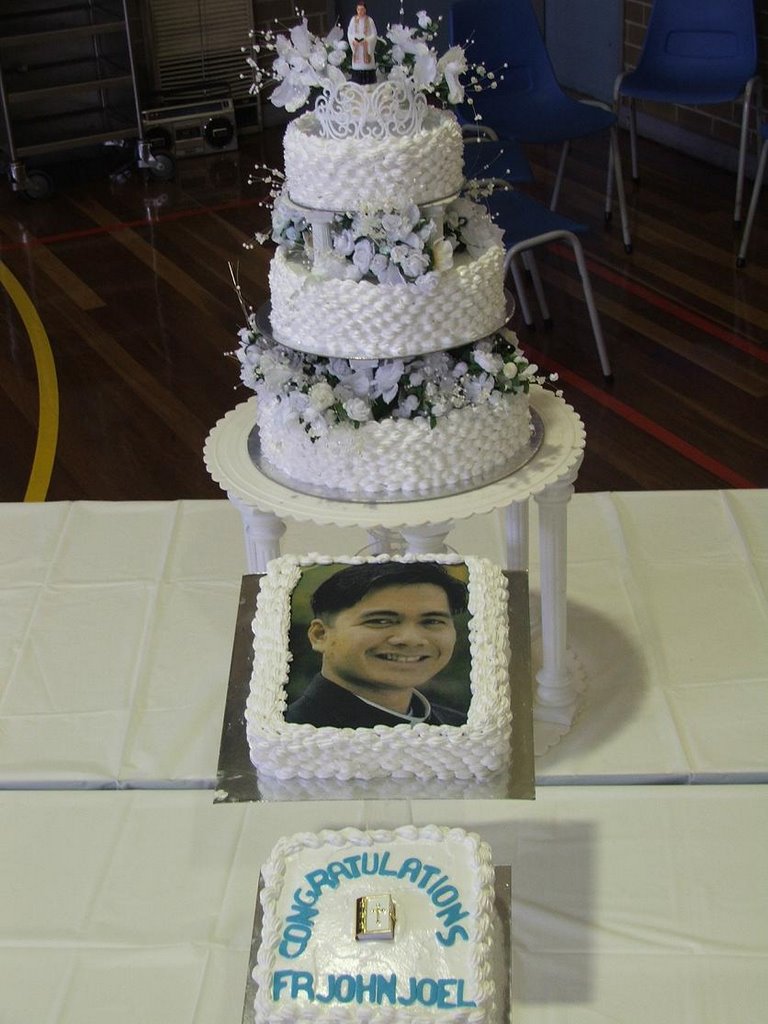
On a bright, sunny morning on Saturday, 16 September, hundreds of people made a pilgrimage to St Patrick’s Cathedral to celebrate the ordination to the priesthood of four men: Eugene Ashkar, John Joel Vergara, Thinh Xuan Nguyen and Justin Ford for the Melbourne Archdiocese. In a sight rarely seen, St Patrick’s was filled to its capacity. The throng of people who gathered in the Cathedral mirrored the diverse composition of our Melbourne Church, with people of all backgrounds coming together to celebrate the occasion.


Aside from the very different cultural backgrounds of the four men, perhaps part of the reason for the cosmopolitan audience present at their ordination can be traced to the positive impact these men have already made on our community: all have previously served in Melbourne parishes as deacons, and all have had pastoral years here. It is fortuitous that their multifaceted ministry continues in our great city.

Read more...

Sunday, September 24, 2006

the last and the least

Mass of Thanksgiving and First Holy Communion
Holy Child Parish
Dallas
September 23, 2006


‘Anyone who welcomes one of these little children in my name, welcomes me; and anyone who welcomes me welcomes not me but the one who sent me.’ Mk 9:37

Once there was a small village that was stricken by a terrible drought. People were panicking and were all worried about their crops and animals. Living in this desperate situation, people thought of going to their old parish priest to ask for help. The parish priest suggested that everyone should be united in prayer, asking God for the rain. He instructed the people to gather in front of the Church the next Sunday morning and asked the people bring with them anything that symbolizes their faith.

When the day came, as instructed, the people gathered outside the Church to pray for the rain and with them a symbol of their faith in God. The priest was delighted to see his parishioners holding rosary beads, some brought their bible and holy images, and others came with crucifix of different sizes.

But everyone was all surprised when they saw a little boy wearing a raincoat and holding big umbrella.

Today, we heard from the Gospel Jesus asking his disciple to welcome the little children if they want to receive God in their lives. Jesus fondly used the characteristics and qualities of the children to describe what it is like to be his true follower.

The child is the symbol of someone who is small, powerless, and innocent. Children have a strong faith; they acquire the quality of total dependence from their mum and dad. Children are not afraid to be who they are. They cry one moment and laugh the next moment. Children are not image-conscious. Children are not afraid to get hurt for being known for who they are. Children are free to be who they are, they seem playful and joyful at all times and very pleased at whatever they are doing.

Unlike Jesus’ disciples, who are arguing who is the best, the greatest, or the coolest among all, children don’t desire to be great or popular. As the apostles’ attention was focused on honor and glory and on who was the most important one, children on another hand are pretty much content with what they have. Children are contented even when lack material goods, they stand in need of spiritual blessing promised by God. That is why children are so loving and lovable.

So when Jesus heard that his apostles were discussing about their personal dreams and ambition to be great, Jesus immediately stopped their conversation and pointed out to them that if they wanted to be popular they must serve others in love. If they wanted to be the first, they need to get rid of their pride and ambition; they have to seek the last place because greatness asks that one be the servant of all.

We will never find in the Gospel Jesus teaching his apostles to boast for their works or to seek their own glory. Rather, Jesus’ teachings are all about self-sacrifice, humility, love, tenderness, compassion and forgiveness. As Jesus said: “If anyone wants to be first, he must make himself last of all and servant of all.”

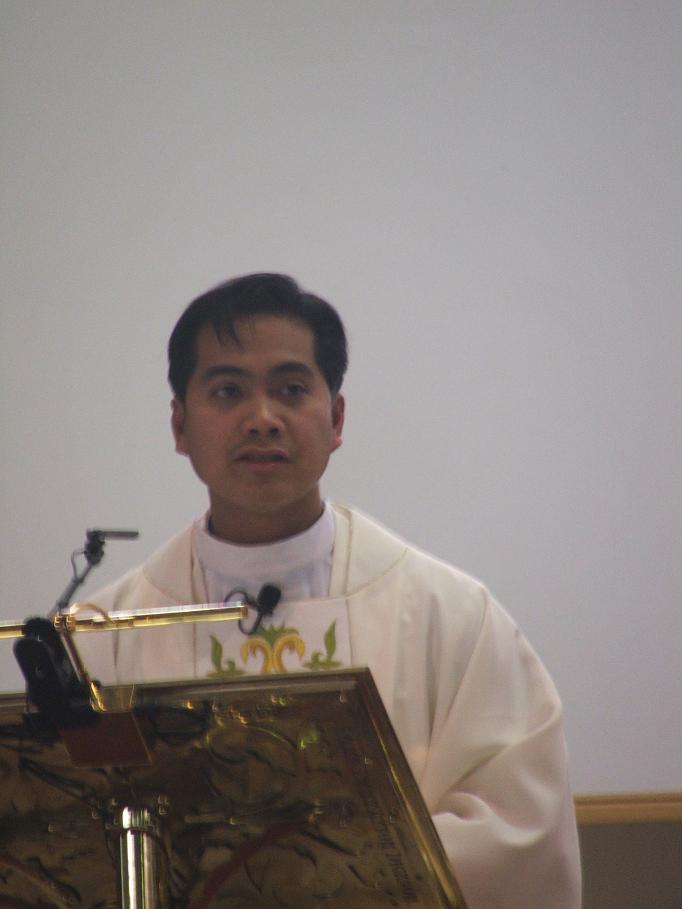
Personally, this particular passage is a challenge for me as a newly ordained priest – I am a one-week- old priest to be exact. I was ordained together with my three fellow “baby priests” in St. Patrick Cathedral. There were so many people I really I felt like a celebrity. People wanted to take photos with me; some people were asking me to sign the Mass booklet; others were even asking my phone number; and I’ve got lipsticks all over my face.

For awhile I felt like a celebrity, or an Australian idol, but I always reminded myself that people admired me not really because of me but because of Christ who rests in me, and in my priesthood. Jesus Christ came in this world to serve the poor and little ones, and so like Christ, I am also called not to be served but to serve. It is my prayer as I begin my priestly journey that my faith and love of God will be like of a little child who trusts lovingly and rests contently with his or her parents.

Also, it is very fitting that this evening six children from our parish will advance their Christian journey as they receive Christ for the first time in Holy Communion. It is also very fitting that the Gospel today tells us an occasion when Jesus welcomes the children and lovingly puts his arms round them. In the Holy Communion Jesus will not only put his arms round these children but indeed Jesus will nourish their spiritual needs and keep them under his love and care. In Holy Communion, they will receive Jesus Christ, who offered for us the most perfect act of love - the total sacrifice of self – by his death on the cross and glorious resurrection.

As we continue in this Eucharist, could I ask you to please pray for these children that they may grow in their faith and love in Christ. Please pray for Fr. Justin, Fr. Thinh, and Fr. Eugene who were ordained with me last Saturday that we may always be faithful to our vocation. And let us pray for one another that we may imitate the little children, so that we can share the glory of our Lord Jesus Christ. Amen.

Friday, September 22, 2006

Lorenzo & Matthew

Novena Mass for San Lorenzo Ruiz
St. Brigid’s Church, North Fitzroy
September 21, 2006
Feast of St. Matthew, Apostle and Evangelist
Eph 4:1-7, 11-13; Mt 9:9-13

“Name”
It was said that yesterday there were around 300 million people around the world who watched the memorial service of Steve Irwin. Although I was not able to watch this event on tv I saw in the internet when Steve’s daughter, Bindi Sue, confidently delivered her touching speech about her dad. Do you know that Bindi Sue is named after Steve’s favourite pet snake “Bindi” and pet dog “Sue.” Galing!

Pero di pa rin papahuli ang Pinoy pag dating sa pangalan. Filipinos are also creative in naming their children.

Actually today is the birthday of my sister Marsha. My sister is born in 1975 on the 3rd anniversary of the declaration of Marshal Law by the late President Marcos. And I was named after “John Puruntong” from the comedy sitcom “John n Marsha.” Funny enough I watched last night its updated version “John n Shirley” on TFC.

The calling of Matthew
I’m sure there are many interesting stories behind the names of people we know. In the Gospel reading today we heard a story of a certain man named Matthew. I didn’t have time to look up today what Matthew’s name stands for however the scripture and tradition tell us some background about this man.

Matthew was a sinful man. Isa po siyang tax-collector. People at the time of Jesus regarded tax collectors as notorious corrupt individuals. The Pharisees branded them as the worst of sinners along with thieves and prostitutes. In fact even the beggars refused to receive alms from tax collectors.

Matthew was regarded as a public sinner. He had no friends. He was isolated from the society at his time. When Jesus saw him sitting at his office doing his taxation work we can easily imagine that Jesus must looked at him with him interior pity. Jesus undoubtedly saw in Matthew his deep thirst for compassion, for friendship, and most of all his for God.

When he heard the simple command of Jesus “follow me,” Matthew made no delay, but “got up and followed him.” Hindi na siya nagpatumpik-tumpik. Wala siyang ‘mamaya-na’ habit. At this point in his life Matthew would never be the same person again.
Matthew through the inspiration of the Holy Spirit allowed Jesus to heal, restore and transform his new life. Jesus' command, “follow me” turned Matthew's life upside down.

Matthew who once owned considerable wealth, stood up, and followed Jesus immediately. He would be aware that Jesus had no earthly wealth, but realised that Jesus is the only One who can give him everlasting treasures in heaven.

Discipleship
In fact the meaning of discipleship is to turn one’s life upside down for Jesus. The words of Jesus “Follow me” is a gentle command to imitate Jesus not only in words but more importantly in actions. To imitate Jesus is to radically change our lives – since discipleship as I mentioned is “to turn one’s life upside down for Jesus.”

Our very own Saint San Lorenzo Ruiz, literally “turned his life upside down” for Jesus. Binitin po siyang patiwarik. He was hung from the gallows by his feet, his body falling into a pit. Refusing to denounce his Christian faith, he told his executioner that he was ready to die for God and give himself for many thousands of lives if he had them.

Application
I think the challenge for us all here this evening to have a sense of urgency and readiness to “turn our lives upside down” in following the call of Jesus. Like Matthew we are called to “get up immediately” to do what God wants to do.

Jesus wants us to be like him for one another, in our society, in our workplace and in our own family not tomorrow, but now. The first reading directs us how can we do this, it says “Bare with one another charitably, in complete selflessness, gentleness and patience.”


In this Novena Mass, let us remember that God is calling us by our own name to follow him. Let us pray that the Lord may help us to put the teachings of the Gospel into practice and courageously give testimony of our faith in the midst of the contemporary society to which we belong, through the intercession of St. Mathew, and of San Lorenzo Ruiz, who consecrated the whole of their lives to the cause of Christian faith. Amen.

Tuesday, September 19, 2006

Wedding party

salamat sa sponsor

hating kapatid tayo

kasama ang ama't ina sa stage


saya parang fiesta

Monday, September 18, 2006

First Mass Homily


St. Peter Chanel Parish, Deer Park September 17, 2006
‘If anyone wants to be a follower of mine, let him renounce himself and take up his cross and follow me. Mark 8: 35


Uncertainty, anxiety and fear of what the future holds – these were the feelings I had in my prayers twelve years ago every time I would visit the church after sending my sister Maricon off to her school every morning. It was the moment in my life when I think I prayed really hard for the first time as I was waiting for the result of my entrance exam for the seminary in the Philippines.


My prayers were filled with uncertainty, doubt and fear -- I wasn’t sure whether I would pass the examination or not; and if I passed it I wasn’t sure then if I really wanted to become a priest. It was also unclear to me at the time that God wanted me to become a priest.

At the age of sixteen I started my seminary training, and during my early years of formation I still carried with me fear, uncertainty and doubt. Although I have always wanted to follow Christ and do his will, I was afraid and uncertain about my vocation -- I was afraid to become a priest. I feared of surrendering my personal dreams and happiness.

Then after years of discernment, through the grace of God, and with the help of other people’s prayers, somehow my faith has grown in maturity. Gradually I saw more clearly the vocation God intended for me. And finally, yesterday I was ordained priest!

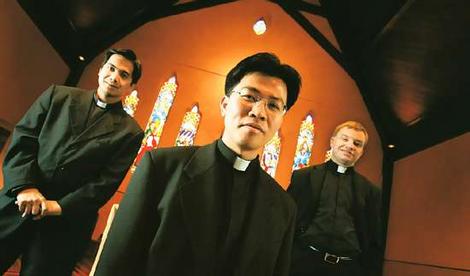
I had the privilege to be ordained to the priesthood at St. Patrick’s Cathedral together with my fellow “baby” priests, Fathers Thinh, Justin and Eugene. At the ordination Mass four of us formally said our “yes” and expressed “our willingness to follow Christ’s call” no matter what. By the virtue of the Sacrament of Holy Orders all four of us became Christ’s representatives. By the power of the Holy Spirit, we were configured to Christ to dedicate our lives completely to his Church, and for the sake of the Gospel.

It is very appropriate that the Gospel reading today speaks clearly about discipleship in its deepest meaning: ‘If anyone wants to be a follower of mine, let him renounce himself and take up his cross and follow me.

However, the message of the Gospel today doesn’t apply only to me as a newly ordained priest or to my brother priests, but the word of Jesus applies to everyone here in this Church.

Regardless of what state we find ourselves in, as Christians, we are all called to follow Christ.

The first condition in following Christ is to know him in a personal and intimate manner. Jesus asked Peter “Who do you say I am?” because Jesus wanted to hear from Peter’s own lips his personal understanding about him. Peter answered on behalf of the disciples, confessing, “You are the Messiah.”

Peter’s answer was right but he couldn’t accept the fact that suffering was to be part of Christ’s mission of salvation. Peter could not make sense at all of why Jesus, the Messiah, the Son of Man, would suffer and die just like any human being. Peter and the disciples had seen Jesus performing miracles, healing the people and even raising the dead. So it was just too much for them to understand how Jesus, their Lord and Master, in the end would suffer helplessly and would be put to death.

Sometimes when we’re confronted with the necessity of suffering, we react exactly like Peter. The suffering we face could be a financial or health problem or the death of a loved one; we react like Peter who doesn’t clearly understand the important role of suffering in our lives. Sometimes we fail to answer correctly the personal question of Jesus “Who do you say I am?”, most especially in our present society, where interpretations of suffering and failure are dominated by a “culture of success” and the image a “trouble-free society.”

In the light of today's Gospel, we must insist that Jesus Christ, our Lord, is not a triumphant Messiah, but a suffering one who saved us and the world by humiliation, defeat and surrender.
The messianic expectation of God’s people was contradicted by the actual messianic role of Jesus because he didn’t preach armed revolt and a war of political liberation. On the contrary, his appallingly painful and utterly disgraceful death not only manifested his true identity as Son of God the one who brings about salvation for others but also fulfilled his prediction of himself as the “suffering messiah.” We heard this image of the Suffering Messiah in the First Reading: “I gave my back to those who struck me, my cheeks to those who tore at my beard…”

Jesus’ own suffering and death, and his glorious resurrection reveal to us that the mystery of human suffering can have a redemptive role in our lives and the lives of others. But of course God doesn’t want us to suffer; he doesn’t delight in human suffering. God is the source of all goodness. He knows and understands our sufferings and sacrifices; he knows our individual struggles, our loneliness, bitterness and fear.

Suffering for parents could be the challenge of raising their children. Suffering for young people could be the feeling of meaninglessness or losing the sense of purpose in life. Suffering of elderly people could be the feeling of rejection and being abandoned. Suffering for others could be separation from family and loved ones. Our suffering could be our own struggle against our addiction to sin and our own weaknesses.

The words of Jesus in today’s Gospel, ‘If anyone wants to be a follower of mine, let him renounce himself and take up his cross and follow me’ are an invitation for us all to put our suffering into the perspective of love and self-denial.

To follow Christ willingly and to trust his word, cannot avoid accepting suffering as part of it. Even Mary, Christ’s very own Mother was not spared her own cross of suffering, from the moment she conceived her Son until his death on the cross. But in the end, we learned from her, how to surrender, obey and believe even in times of pain and desperate hope.

When Jesus says, “take up your cross,” he is not just referring to major sacrifices like accepting martyrdom. He is also referring to the daily sacrifices of love that animate our lives. It is true that the concept of sacrificial love is completely opposed to the mindset of today materialistic society. Therefore in this Eucharist let us pray for one another and ask God to give us all the ability and the courage to love, to deny ourselves and endure sacrifices because of love.

Uncertainty, anxiety and fear of what the future holds – these were the feelings I had twelve years ago. I admit this is also how I feel now, but the words of Christ “take up your cross and follow me” no longer appear a threat but an assurance that grace accompanies every cross we carry, when we depend more on God than on ourselves.

Let us remember that when there is some pain in our lives, when we have to carry a cross, it is an opportunity for us to forget ourselves and put Jesus alone as the center of our life. Amen.
Wednesday, September 13, 2006

Proud to be Pinoy

Sa unang kita ko lang pa lang sa iyo ay nasabi ko sa sarili ko "parang kilala kita ah." Nilapitan kita at pabulong na kinausap "aba ikaw nga" (kumakabog pa ang puso). Paikot-ikot ako sa iyong harapan at palingalinga na sana ay may kapatid din na mapadaan. Pero wala.

Sabi ko sana sa susunod na tayo magkita ay kasama na kita pag-uwi ko. Excited na excited ako nun.

Ganon nga ang nangyari. Sa ikalawang pagkakataon na tayo'y nagtagpo di na kita pinakawalan. Taas noo akong naglalakad at sa lahat ng kakilala ikaw ay iwinawagayway.


"This Air Force 1 has been produced to celebrate the life and times of the Philippino (Filipino) hero, Jose Rizal. The upper features a suede and patent leather upper and has been designed in the colourway of the Philippines national flag."


Astig ang Pinoy. Proud to be Pinoy! :)

Saturday, September 09, 2006

Happy Birthday Mama Mary

In every aspect of her life Mary knows that her role is to subordinate herself to Jesus. Mary, who was so close to the human Jesus as his mother, had devoted her life from the moment she conceived him and never left him, even at the cross. Mary is the first disciple of Christ and a perfect Christian because she remained in full humility under the shadow of her Son. In Luke’s Gospel the first misunderstanding Jesus has with another person is with his mother. After finding the child Jesus who went missing at the temple, she rebukes him saying, “Son why have you done this to us? Don’t you realize that your father and I have been full of sorrow while searching for you? ” Then he said to them, “Why were you looking for me? Did you not know that I must be in my Father’s house?”[1] Mary does not understand, and so she returns to reflection, thought, and prayer, seeking to learn from the Spirit what her growing son is about: who he is and what he is becoming.[2]

Scripture presents Mary like Jesus, who grows in age and wisdom, as she accompanies the growth of her son – she keeps in her heart everything that Jesus says.[3] She treasures words, events and thoughts of her son Jesus. She knows that she is just a handmaid of the Lord who is called to obey what her Lord asks her to do. St. Augustine affirms Mary’s faithful discipleship saying that she first conceived Christ through faith before conceiving him in the flesh.[4] For this, Mary is a perfect model disciple: one who faithfully believes every word of Jesus Christ, and then goes to believe his promises more and more until his death and resurrection. Mary as a servant of the Lord, has no other model other than her son Jesus Christ himself. All of Mary’s titles and attributes point to glorify Jesus, the Servant of God, who in his faithful obedience to the Father has suffered and died on the cross. Mary is the first disciple of the New Testament, who learned from Jesus what it means how to surrender, obey and believe even in times of pain and desperate hope. So, deep in the heart of Mary lies a prayer of humility and faithfulness that we all Christians are ought to say as well in the depths of our being: “Jesus, make me a servant only like you.”


[1] Lk 2:48-52.
[2] Megan McKenna. Mary Shadow of Grace. (New York: Orbis Books, 1996) 95.
[3] “As for Mary, she treasured all these things and pondered them in her heart.” Lk 2:19.
[4] Bertrand Buby S.M., Mary the Faithful Disciple (Mahwah: Paulist Press, 1985) 13.

Tuesday, August 29, 2006

The Hubbard Family

For the first time after eleven years the Hubbard family had been reunited -- where all seven of us were present at the same time and at the same place.


Before...


after 11 years...

With our new members (one still to come!)

Conversion

"Late have I loved you, O Beauty ever ancient, ever new, late have I loved you! You were within me, but I was outside, and it was there that I searched for you. In my unloveliness I plunged into the lovely things which you created. You were with me, but I was not with you. Created things kept me from you; yet if they had not been in you they would have not been at all. You called, you shouted, and you broke through my deafness. You flashed, you shone, and you dispelled my blindness. You breathed you fragrance on me; I drew in breath and now I pant for you. I have tasted you, now I hunger and thirst for more. You touched me, and I burned for your peace."

from the confessions of Saint Augustine

Sunday, August 27, 2006

The Greatest Commandment

The Greatest Commandment
Mt 22:34-40
August 25, 2006
Corpus Christi College

There are many occasions in the Gospel when people come to Jesus to ask him questions. The Gospel last Monday, if you remember is about the story of the rich young man who asked Jesus how to gain eternal life. In today’s Gospel, a lawyer or a student of the Law is the questioner of Jesus.

Unlike the rich young man who sincerely asked Jesus on how to gain eternal life, the lawyer approached Jesus “to test” him by asking which commandment in the law is the greatest. According to most commentaries, this person represents the Pharisees who want to distinguish and select from some 613 laws and commands of the Torah the first and the greatest commandment. Knowing well his questioner’s intentions Jesus refuses to play the Pharisees’ attempt to catch him in a mistake.

Jesus’ answer to his question is not a categorical answer stating the greatest commandments. Rather, he gives the double commandment of love that can summarize the Law and the Prophets, the meaning of life, and the entire Gospel: to love God with all our heart and all our soul and all our mind, and to love our neighbours as ourselves.

The first commandment calls us to remember part of the Jewish profession of faith, the Shema: “Love the Lord your God with all your might.” And this reminds us that to love God with all our heart…soul and mind.. is more than a feeling or emotion but it is a matter of faithfulness and commitment, both in words and actions. Since God is truth and goodness itself, and since he has loved us with everlasting love, we ought to love him above all creatures and with our entire being.

The command to love God has as its inseparable counterpart the command to love neighbour. To love one’s neighbour as oneself means to love him as we should love ourselves. We must love our neighbour as ourselves because they too are children of God, they carry in their soul the image of God, they have human dignity, and like us, our neighbour are destined for eternal union with God through love. This reminds us that the best way to understand how we can love God and how God loves us and how to pray is to think in terms of a relationship based on charity.

Jesus teaches us that charity is the greatest and first commandment because he whom we are to love is God, infinitely perfect, containing within himself all beauty, truth, goodness and love, because the purpose of all the commandments is our union with God in love. If we fail to observe charity, we fail in all, for all other commandments reduce themselves to charity.

So as men who are preparing for the priesthood, let us pray that God will increase his grace upon us and help us to love him with all our heart soul and mind in every circumstances of our life. Let us also pray that our desire to follow his Son, our Lord, may be transformed into a pure love, which is faithfulness and commitment, both in words and actions.

Saturday, August 05, 2006

Food for Life

SUNDAY HOMILY: 17th Sunday in Ordinary Time
Holy Child Parish, Meadow Heights
July 30, 2006

Once there was a priest who was sent to a country parish in Peru. After several weeks of learning Spanish he felt terribly lonely and homesick; missing his former parishioners.

He thought of getting a pet to give him company. Off he went to a nearby pet shop. Going through all the pet animals, he decided to buy a talking parrot.* “I know this one is very expensive, but I am sure this will cheer me up,” he said to himself as he excitedly brought it to his presbytery.

But several days passed and the parrot hadn’t uttered a sound. The poor priest went back to pet shop owner and complained.

“What it needs is a ladder for the cage,” the man said. “When it goes up and down, it’ll start talking. But the parrot didn’t speak a word. So the priest returned and complained.

“Ah, Father, what it needs is a swing,” the owner said. But a week went by, and still the bird didn’t talk. When the priest returned to complain for the third time, the pet shop owner said what it needed was a mirror in the cage. But again it didn’t work.

Another week passed and the priest came back to the pet shop, this time he was mourning. He reported that his expensive parrot had died. The owner was embarrassed. “I’m sorry to hear that Father, but did it say anything at all?”

“Yes,” said the poor priest. “As my parrot drew its last breaths, finally it spoke. It said: “Father, don’t they have bird food in the pet shop?”

The priest and pet shop owner were so preoccupied with the bird’s various needs that they forgot the one most basic need – food!

***


The readings we have today this Sunday speaks of hunger for food, and how God is concerned with this hunger. Food is one of the basic needs for everything living things in order to survive - plants, animals, and human beings need food!

We need regular nourishment to keep us going with our daily activities. People go for work so they can earn money, and afford to provide descent meal for his or her family. Because food sustains life, without food we will get hungry, deteriorate and eventually suffer the grim fate of the talking parrot in the story.

In the first reading, prophet Elisha attends to the hungry crowd with barley loaves and fresh grain. With the help of God he performed a miracle so that was able to feed hundreds of people. This story finds a parallel in the Gospel reading today – Jesus fed food to 5,000 men! Imagine if we include their wives and children, there were at least ten or twenty thousand people. But Jesus managed to provide them an abundant meal – more that they could possibly eat. The Gospel says the disciples gathered twelve baskets of scraps left over from the barley bread.

You may be wondering where these crowds came from and why they were following Jesus? At that time Jesus had already attracted many people because of his teachings, sign and miracles. Jesus was like celebrity – people were following him wherever he goes. Probably many were attracted only out of curiosity wanting to find more about this person.

That day a great crowd had gathered around Jesus. Instead of giving them long discourses or sermons Jesus felt immediately their needs – these people were tired, exhausted and hungry. For that moment Jesus’ priority was to attend their hunger. Indeed one cannot preach the Word of God to people with empty stomachs! So he asked Philip, “Where can we buy food for these people to eat?” To cut the story short the crowd got a good feed – for free! They were all satisfied and for sure they gained weight as well!

****

I don’t think lack food is a problem in a rich country like Australia. Some people in rich countries are more concern about whether it is healthier to be a vegetarian or not. Whereas in poor countries, people don’t have a luxury of choosing between beef and vegetables; millions of people are dying from hunger,

Food is very important, but still, food is not the only thing that matters. Even if we eat three times a day, still we experience interior or spiritual hunger that only God can satisfy.

The Gospel reading today, is not much about the miracle of multiplication of the bread, but it is a story where Jesus leads his followers to recognise the Bread that does not perish. Jesus is preparing the people for the greatest miracle, when he will offer himself as the giver of life at the Last Supper. We will hear about this theme the next coming Sundays. If you go to Mass next Sunday, (I’m sure you will) you hear Jesus speaking about bread becoming his very Flesh, and wine as his very Blood. Jesus is the Bread of Life from Heaven that nourishes people’s spiritual hunger.

In fact, this is what we are going to receive today in the Holy Communion. In the every Eucharistic celebration, Jesus offers himself as the Bread of Life, to nourish our spiritual hunger and needs. More than this Jesus promises eternal life to whoever receives this food: “He who eats my flesh and drinks my blood has life everlasting and I shall raise him up on the last day.”

So as we receive Jesus later on in the Holy Communion let us express our thanks and praise to God for this great opportunity, which not everyone has, or some people take for granted. After we receive Holy Communion let us allow God to fill up our interior longing, and spiritual hunger that material things cannot fulfill. Finally, let us pray that through this Eucharist each one of us will come closer to Jesus – the Bread of Life – so that we may not experience hunger but gain EVERLASTING LIFE.


* Adapted from the story of Fr. Ben San Luis SVD

Wednesday, July 26, 2006

pagtatagpo

panalangin ko sana ay
makapiling ka
sa bawat sandali ay
makasama ka

sa aking pag-iisa
ikaw ang nakikita
alam ko bukas
ay may darating na
umaga

panalangin ko sana ay
matagpuan,
ang Kalooban
nya’y ikaw sana

Chorus:
Muling magtatagpo
ang ating puso
pagsasaluhan ang
pag-ibig na Kanyang handog
Huwag nang matakot at
di na muling maghihiwalay
Sa piling Niya tayong dalawa
magsasama habang buhay.

panalangin ko sana
ay ialay sa Kanya
bawat sandali ng
ating buhay

pagkat ang puso natin
ngayon ay iisa
sa Panginoon habang buhay
tayong magsasama.

October 1, 2002
Feast of St. Therese of the Child Jesus