Here is a letter to priests from Claudio Cardinal Hummes, the new prefect for the Congregation for Clergy.
My dear brother Priests,
I have felt a desire to address a cordial greeting to you, even if only through our Internet site.
I have been in Rome for a brief time, called by our beloved Pope Benedict XVI to cooperate with him in the service of love toward the priests, deacons and catechists of the Church.
In the first instance, you know that I must offer a deferential note of gratitude to Cardinal Dario Castrillón Hoyos, my immediate predecessor. It is thanks to his vision that I can now entrust my words to the mysterious paths of the heavens.
He has been a true friend of priests. He has carried you in his heart as a pastor; he has prayed for you; he has loved you.
Dear friends, it now falls on me to carry you in my heart, to pray for you, and to love you.
I cannot hide that I still feel like of a "novice." I have also had a bit of nostalgia on leaving São Paulo in Brazil. But, like Abraham, I trust in my Lord and God. I am here to be a bishop for you and a priest with you.
To serve priests! What a mission! What an "amoris officium!"
We are bearers of a specific identity that constantly characterizes us in our existence and in our activity. We are consecrated and incorporated into the activity of Christ. The gestures and the words of Jesus become re-actualized in time and in history to elicit in those who fulfill them "the same sentiments of Christ" and the same effects of salvation. The Church, in conferring the sacrament of orders, ontologically constitutes the priest as an "alter Christus," or as some say, an "ipse Christus"; and it establishes him as a minister of the word and as a minister of the prophetic action and pastoral love of Christ. His function, therefore, is not to exhaust himself exclusively in the dimension of worship, but to fulfill himself in the prophetic dimension by proclaiming the word and in the pastoral dimension by being a guide for the community.
Among the beautiful expressions of the Second Vatican Council is the following statement, which synthesizes the functions of the priest while delineating his identity: "Priests, while engaging in prayer and adoration, or preaching the word, or offering the Eucharistic sacrifice and administering the other sacraments, or performing other works of the ministry for men, devote all this energy to the increase of the glory of God and to man's progress in the divine life" ("Presbyterorum Ordinis," 2).
Dear brothers, we are proud and joyful of our priestly identity. We are proud to be priests.
It is true, ours is not an easy mission. But united to Christ the eternal High Priest, and with Mary, Mother of the first Priest and of all priests, we will always be mindful of giving testimony to the hope that is within us to our numerous brothers and sisters who, even today, long for the way, the truth and the life.
From the Vatican, Jan. 24, 2007
Memorial of St. Francis de Sales
Claudius Cardinal Hummes
Prefect of the Congregation for Clergy
I'd like to highlight his words again, "we are proud and joyful of our priestly identity. We are proud to be priests."
source: www.zenit.org
Sunday, January 28, 2007

Saturday, January 27, 2007
New Year's Resolution
Hango sa liham ko sa aking mga magulang (naks parang sulat ni Rizal, makabagbag damdamin).
"4pm nagpunta ako sa appointment ko sa gymnasium. Oo nga sa wakas natupad na rin ang new years resolution ko. Bale unang session palang naman. 1minute drive lang ang layo ng gym. Tinimbang, sinukatan ako at binilang kung gaano kadami ang taba ko. Babalik ako sa Tuesday para ibigay ang program ko. Yun lang."
Tatlong taon ko na itong new years resolution.
Matupad kaya?
Abangan.
Happy Australia Day!

"I suppose I am the only one present here today who is not an Australian citizen. However I have been in Australia for six years now and I have been always grateful and I feel blessed living in this beautiful country 'down under.'

Although I am not an Australian citizen, Australia is now my adapted country or I should say Australia has adapted me.

So I am speaking today with same sense of gratitude and joy of a fair dinkum Aussie as we celebrate together Australia Day this year 2007.
Today, we come together as a nation to celebrate what's great about Australia, being Australian, and being in Australia (as in my case). It's the day to reflect on what we have achieved and what we can be proud of in our great nation. It's the day for us to re-commit to making Australia an even better place for the future...
...As we celebrate Australia Day with great sense of gratitude, let us pray that our homeland Australia may be transformed by the message of the Gospel and truly become a Christian nation."
----
Excerpt from my homily today
Mabuhay ang Australia! Mabuhay ang Pilipinas!
Wednesday, January 24, 2007
Happy Feet
May mga ngiti na laging hinahanap-hanap.

(icmas january 2005)
Ngiti ng pag-kakaibigan.
 (icmas november 2006)
Malayo man at kahit saan, ala-ala ay di malilimutan.
Hello M' Lenie at M' Tina!!! :)
Tuesday, January 23, 2007
Anointed to Preach
Third Sunday in Ordinary Time C
January 21, 2007
Reading I: Nehemiah 8:2-4a, 5-6, 8-10Responsorial Psalm: 19:8, 9, 10, 15Reading II: 1 Corinthians 12:12-30 or 12:12-14, 17Gospel: Luke 1:1-4; 4:14-21
January 21, 2007
Reading I: Nehemiah 8:2-4a, 5-6, 8-10Responsorial Psalm: 19:8, 9, 10, 15Reading II: 1 Corinthians 12:12-30 or 12:12-14, 17Gospel: Luke 1:1-4; 4:14-21
A priest came out to say Mass with his face plastered with band aids.
“I’m sorry I look like this,” the priest said as he started his sermon. “This morning as I was shaving and thinking of what to say in my sermon, I cut my face.”
After the Mass, while he was going over the collection, he saw a note which read: “Father, next time shave your face and cut your sermon!” [1]
Some people say a short sermon moves the heart a long sermon moves the chair. I hope my homily today is not too long before you move out from your seat. Anyway, I would say the best sermon or homily is indeed one’s good example. There are some people who are so holy enough that they do not need to preach. (How I wish to be like that!)
In the first reading we heard from the book of the prophet Nehemiah about Prophet Ezra who is a priest and a prophet in the Old Testament. He presents the Law of God to the people consisted of men and women, and those children old enough to understand. As a priest his job was to interpret the God’s commandments to people so that all could understand and applied to their day to day life.
In the Gospel, we heard another preacher and teacher, he is the greatest of all preachers, and his name is Jesus. As St. Luke writes, the news about him spread throughout the whole region. He was so popular that people in Galilee and everywhere, were following him to hear him preach and teach. He has a special gift or aura that can attract great crowds that can touch their hearts and souls.
Secondly, Jesus speaks with authority, unlike the Pharisees at his time, he practice what he preach. In the Gospel story today, Jesus was telling the people (and us today) the fulfillment of words of the prophet Isaiah written several hundred years before him: The Spirit of the Lord is upon me, because he has anointed me to bring glad tidings to the poor. He has sent me to proclaim liberty to captives and recovery of sight to the blind, to let the oppressed go free, and to proclaim a year acceptable to God.
Rolling up the scroll, he handed it back to the attendant and sat down,and the eyes of all in the synagogue looked intently at him.He said to them, “Today this Scripture passage is fulfilled in your hearing.”
We are all Preachers
Throughout the world Jesus looks for instruments through which he can continue his teaching. We Christians St. Paul says in the second reading are members of the one Body of Christ. We are one body in Christ. Each one of have specific roles in building our community. One of our roles is to preach the Word of God to other people. Priests like Fr Frank and myself are not the only preachers. Parents preach too as also teachers in school and supervisors and bosses. Anyone in authority has to teach what to do and what not to do. You may not have the opportunity to preach in the pulpit like I do but as followers of Christ you too can preach his love and teaching through your example of forgiveness, mercy and acts of charity.
Jesus commissions us to spread God’s word to others since is his word gives wisdom, enlightens one’s mind, his command gives healing, and meaning. As we all proclaim together the Responsorial Psalm: Your Word, Lord are Spirit and life. But how can we preach about the love of Jesus, his teaching and his example if we are not familiar with the Word of God? When was the last time you open your Bible at home?
Perhaps the most constant failure of Christians is our reluctance to take our own Gospels seriously and entirely. If you remember I mentioned last week a quotation from St. Jerome, a 5th century saint, who said, “Ignorance of the Scripture is ignorance of Christ.”
According to the Second Vatican Council, the word of God provides us food for our souls, a pure and unfailing fount of spiritual life. We can buy all sorts of self-help book in the shop, books on new age spirituality, well-being, etc, however, still the word of God, the Bible is more important in our life as Christians because this book narrates the most important event in the history of People of God. In the bible we encounter, we relish the presence of Jesus Christ, who is the way, the truth and the life. Each time we open and read the Bible we learn and live the holy will of God, through the Holy Spirit.
As parents it’s your task to educate your children to our faith. Young people and young adults too must share their contribution in evangelizing the word of God.
Let us pray then that we may proclaim the Gospel, the good news of our salvation.
“Lord, we pray that our church may help men and women of every culture to unroll the sacred scrolls of their tradition, read attentively and reverently what is written there. Help us to follow Jesus and help each of us to recognise that the ancient scriptures are fulfilled in us.” Amen.
[1] From More Stories of Life and Laugther by Fr Ben San Luis SVD p 67.
Larawan, Kasalan
 Ahem..welcome to Peter and Melissa's wedding.
 Lagot kayo, you are no longer two but one na.
 Happy.
 Arrhae bearer Master Little Johnny, ring bearer Master Luis,
and flowers girls Nicola and Chichi
 Just married.
 At the wedding reception.
 Just married.
 At the wedding reception.
I just remember I forgot to sign the marriage certificate! :)
Sunday, January 21, 2007
Peter and Melissa's Wedding
Our Lady of Mt. Carmel Church
Sunbury 11:00am,
January 20, 2007
Genesis 1:26-28, 31a, Psalm 32,Ephesians 5:2a, 21-33
The celebration we are having today in this beautiful and historical church of Our Lady of Mt. Carmel all started with exchange of text messages two years ago in the Philippines.
Peter and Melissa met each other through my friends, Annette and Aurora, who were Melissa’s former fellow teachers at St. John the Baptist Catholic School in San Juan, Metro Manila. My friends formally introduced Peter to Melissa at Robinson Galleria in Ortigas, where they first met and where they had their first dinner (at Pizza Hut) and their first bonding as friends as they played at the mall’s children’s playground.
Peter and Melissa’s friendship deepened as they get to know each other, and they had to consume more phone cards for text messaging. I can still remember how Peter diligently record Melissa’s every single text messages on his little notebook. Peter’s typical "Vergara sentimentality" was then followed by his frequent visits at Melissa’s school at San Juan…and then, the rest is history.
Speaking of history Peter and Melissa’s wedding today is not only my first wedding this year but also it’s my first wedding as a priest. This is also my first time to officiate a wedding within the Vergara clan (I wonder who will be the next?). I hope the next time we will begin on time![1] So, starting today, Peter and Mellisa, you will begin your journey of life no longer as text-mates or as yahoo messanger chatmates, but now as new Christian couples in our modern society. As Christian couples you are called to be witnesses of Christ’s unconditional love and care to his Church.
My dear friends, it’s a privilege for all of us here today to witness this significant moment of their lives, as they receive the Sacrament of Christian Marriage. As I said at the beginning that Peter and Melissa will pledge themselves before God as husband and wife, who will live the rest of their lives as one. As Jesus says, the two shall become one flesh.
When I asked Peter what he personally think about marriage, he said, “the main words that come to my mind are love, commitment, honour, trust and respect. It’s an unbreakable bond between two people that is blessed by God and His love.” I asked the same question to Melissa, she said, “marriage unites man and woman in an unbreakable bond of love…It is a giving up oneself completely to one another. They (couple) should really love each other unconditionally. They must accept each other’s strengths and weaknesses.”
And so, we are here today, to support and pray for Peter and Melissa, that the biblical message and their understanding of marriage becomes a reality upon their marriage.
The Gospel reading they have chosen for their wedding is about Jesus’ strong position about the permanence of marriage: “What God has united, let no one separate.” Peter and Melissa wish to emphasise to us all here today the seriousness of their commitment. They both believe, they want to preserve, and they are willing to follow the powerful words of Jesus regarding marriage.
As I explained to you Peter and Melissa, and as we all know, the Sacrament of Marriage in the Catholic Church is permanent, lasting, and forever. The Church is faithful to the words of Christ: what God has united, no one must divide. This is the reason why there is no such thing as divorce in the Church. Once you are married it binds you forever until death. The vows you make today are, humanly speaking, not only difficult but impossible to fulfill. So, today, we ask God’s help and protection, for your human love is not enough. We ask the same God, whom we heard from the first reading, the God who created man and woman according to his image and likeness. We pray that his love will bind you together even at times of trials and difficulties.
Another aspect of marriage we heard from the readings is image of leaving one’s father and mother. It doesn’t mean that when you get married you will forget or take for granted your mum and dad, your nanay and tatay. No. Your parents still have important role in your life and will always will. You still need their guidance and support. However, to leave one’s father and mother means, your number one priority, between you and your family, is no longer them, but yourselves as husband and wife.
It’s never easy leaving the comfort of one’s family. It’s is not always easy to leave ones father and mother or one’s family and one’s country for the sake of love. It’s not easy to start a new beginning, but remember that God is also making a vow before you today. He promises to protect you, and help preserve your marriage and keep your love burning. Peter and Melissa, as Christian couple, you are called to nurture your spiritual life by making Christ be the center of your married life. Make Jesus be your first love.
As human beings you will not be able to meet all of each other’s needs, or bring each others’ total happiness and lasting fulfillment. Only God can do these things! Because God never comes into our lives by force, God comes into a marriage only by invitation. Make use of the sacraments of the Church to draw you even closer to Christ and each other. Love the Lord your God with all your heart, mind, soul, and strength. Then, Peter and Melissa, no one will be able divide of your marriage, and you will be able to love one another, as one flesh and one body all the days of your life!
May you enjoy the lasting fruits of marriage. Amen.
[1] The bride arrived 40 minutes late!!
Saturday, January 20, 2007

Thursday, January 18, 2007
Shadows
 A whisper
 A calling from within
 "Stretch out your hand"
Ang mga nagsiganap ng libre...


*artistic shots by joan m.
Tuesday, January 16, 2007
My First Funeral
Funeral Mass for
Dorothy Margaret Miller
29 July 1910 - 6 January 2007
January 16, 2007
St. Andrew’s Parish, Werribee
Dorothy Margaret Miller
29 July 1910 - 6 January 2007
January 16, 2007
St. Andrew’s Parish, Werribee
Ecclesiastes 3:1-9, Timothy 4:6-8; Matthew 5:1-12
It’s a pity that I didn’t have a chance to get to know such a wonderful person such as Dorothy. But I’m glad that I have an opportunity to hear this morning about her long life– how her life story began, her family backgrounds, her love for tennis and knitting, and of course her love and dedication for her family, children and grandchildren.
Each of us here today has our own memories of our parents and grandparents. Today we thank God for the beautiful memories of Dorothy which she shared with us, most especially with her loved ones, for touching their lives, for imparting with them her wisdom, her goodness and her Christian faith.
 This is my first funeral Mass as priest and I feel honoured and find it a privilege to celebrate this Christian funeral Mass for such a well loved person as Dorothy who lived a long life, and who as St. Paul says at the second reading, someone who have fought the good fight to the end who have run the race to the finish line.
Dorothy’s long life which includes her joy, pain and suffering reminds us that life cannot be meaningful without love. This same love brought us here together in this church. Dorothy lived her good span of years and has now gone back to God. Though advanced in years, her death is a separation and a sad loss for her family. Her death is a reminder to us that death is a human reality we face everyday. Whether we like it or not, whether you are young or old, rich or poor, our own death is inevitable. We don’t know the day of our own death but we are sure it will happen. This is expressed powerfully from the first reading from the book of Ecclesiastes: everything that happens in this world happens at the time God chooses.
 But death is not the end of everything. Our Christian faith reminds us that the death of Dorothy is but a continuation of her life with our Risen Lord. Despite sorrow and sadness of death, our consolation and hope as Christians is our confidence that God will take care of her now that her earthly life is over. “Through the liturgy of the Mass we gather in gather in friendship here to ask God welcome Dorothy in his Kingdom. Through this Mass we share in the mystery of Christ who has gone through dear before us and has by his resurrection bequeathed to us all the one sure ground of hope and fulfillment.”[1]
Each person is so valuable in the sight of God that he or she is destined to enjoy a permanence which we call ‘everlasting life.’[2] The Gospel chosen by Dorothy’s family for today’s Mass is about the Sermon on the Mount where Jesus taught the multitude of people the eight beatitudes. They are concerned with virtue and how we can achieve that virtue. The beatitudes are a map of life, a series of directives or guidelines helping us on our journey to be with God, where we can achieve eternal life.
It is our prayer and our hope that our Lord may open wide the gate of heaven for Dorothy and so that she may now receive her great reward of eternal life with him in heaven. We pray from the depths of our hearts that her soul will now finally receive its peace and rest in heaven, where she will enjoy the fruits of her love, labour and sacrifice on earth. May the words of Jesus in the Gospel echoes in her today, Rejoice and be glad, for your reward will be great in heaven.
“We entrust your dear soul, (Dorothy) to the Mother of God, your Mother, who guided you each day and who will guide you now to the eternal glory of her Son, our Lord Jesus Christ. Amen.”[3]
[1] Tom Stack, Funeral Homilies, page 87.
[2] Ibid.
[3] Final words of Pope Benedict in his homily at the funeral Mass of Pope John Paul II
Pictures: Beautiful sunset at Wilson Promontory, Victoria, taken by a friend (either Joan or Patricia?).
Monday, January 15, 2007
Molto Bono Vino (sarap ng wine!)
Second Sunday in Ordinary Time C
January 14, 2007
Reading I: Isaiah 62:1-5
Responsorial Psalm: 96:1-2, 2-3, 7-8, 9-10
Reading II: 1 Corinthians 12:4-11
Gospel: John 2:1-12
"Wedding at Cana"
I remember when I was still a seminarian one of my fears as I approached priestly ordination was to preach in front of many people. Before I couldn’t imagine myself standing in front of a big congregation, where some people are listening some are not, some are interested, half-interested or not interested at all.
***
And now, I, as priest, and as a preacher, one of my greatest fears is to preach about the readings from the Gospel of John. As always with the presentation of the story of Jesus from St. John, it is deeply symbolical and highly theological. Compared with the Synoptic Gospels – the Gospel of Matthew, Mark and Luke, the Gospel of John features long discourses, symbolic feature and images, and the glorification of Jesus as the Son of God, the Messiah.
***
The Gospel reading we have today is the marriage feast at Cana. This story is found only in the Fourth Gospel. This story is rich with symbolic figures and images such as the transformation of water into in a sparkling best wine. (You know, since I arrived at St. Andrew’s, Fr Frank has been taking me around the parish, we had meals with parishioners, most were Italians, so I often got home a bit “sleepy” because wine. Italians never run out of beautiful homemade wine! They are proud to say “molto bono vino.”)
Secondly, in today’s Gospel we can look at the role of the Mary, her powerful intercession and her sensitivity to the needs of those around her. She is compassionate about the situation of the newly wed couple and she knows the consequences if the people found out that they run out of wine. So Mary asked her Son to do something.
Thirdly, we can look at how Jesus came to be involved with the situation, and his immediate response to her Mother, “Woman, how does your concern affect me?”
We also have to know the biblical and theological meaning of the words of Jesus when he said “My hour has not yet come.”
Unfortunately, we don’t have enough time to deal with them individually.
According to some Church Fathers, the story of wedding at Cana is the raising of the dignity of human marriage, the union of man and woman, as Jesus assisted the needs of the newly wed couple.
***
But what really is the core of the Gospel today as we enter the new season of the Church calendar the Ordinary Time? “Christmas season is now over, last Sunday brought an end to stories of Jesus’ birth, baptism and early life. Now it is time to hear about the work of Jesus as a full adult, as the man who was also God’s Word.”
The Church gives us a brief transition this Sunday, a preparation for hearing the narrative of Jesus’ life. We Christians are called through our baptism, to meditate and to contemplate on the life of Jesus. We do this basically by reading the Sacred Scriptures daily.
Sometimes we are engrossed with daily news; we more are excited about sensational stories from the tabloid; we more are eager reading forwarded emails or text messages from our friends than reading the bible. St. Jerome once said, “Ignorance of the scripture is ignorance of Jesus.”
Let us honestly ask ourselves, are we really interested about our faith?
Then, if you are, do you want to hear clearly the message of Christ in the Gospel?
But if you are not, let us ask ourselves what it is that pulls down or shakes our faith?
***
According to John in today’s Gospel, the wedding at Cana is “the beginning of his signs at Cana in Galilee and so revealed his glory and his disciples began to believe.” Once again the glory of God is manifested in Jesus. Last Sunday, we celebrated the Feast of Epiphany of the Lord – the manifestation of God in Jesus. The wedding at Cana may be called “Manifestation at Cana” because Jesus revealed his power and his identity as God. Because of Jesus’ compassion and ability to change water into wine the disciples believed that indeed Jesus is the only Son, the Messiah.
****
This Sunday of the Ordinary Time we begin the long journey of listening to the word of God and reflecting on the life of Christ. Pope Benedict said last year in his message for the 21st World Youth Day: “There is an urgent need for the emergence of a new generation of apostles anchored firmly in the word of Christ, capable of responding to the challenges of our times and prepared to spread the Gospel far and wide.”
So let us be attentive listening to the Word of God and put them into actions.
We don’t need to suffer terrible sickness, cancer, or have a tragic accident in our family before we turn to the Lord.
Let us invite Jesus now, for he is our friend and our God. Let us invite Jesus to transform us, to leave everything into his hands including our fears (my fear of preaching!) and problems, to turn our plain water into sacred wine, so that the fulfillment God’s glory comes to us and that we may share that glory to other people. Amen.
Friday, January 12, 2007
Remembering my parents' visit
October 27, 2006

It's real. Pari na talaga. In front of St. Andrew's Church, Werribee. Ate Zita (between Ama & Ina) my cousin from LA Calfornia has arrived to spend her weekend at Melbourne from her business trip in Sydney.

With Ama, Ina and Fr. Frank - my big brother Priest.

Enjoy the ride!

Di papatalo sa ama.

Tukayo ng Ina - little Patricia celebrates her birthday when this was taken... oopp parang si Volta ina ko. :)

Wow Jeepney in OZ! Exhibit at Bethany Primary School
 Young boys and girls of Bethany Primary School enjoying photo moments with my Ina at Ama as they say "Mabuhay" instead of "cheese."
Monday, January 08, 2007
Epiphany 07
Epiphany of the Lord
St. Andrew’s Parish
January 6-7, 2007
St. Andrew’s Parish
January 6-7, 2007
Introduction before Mass
Today is the Solemnity of the Epiphany of the Lord. The word “epiphany” comes from the Greek word epiphaneia that means “manifestation or revelation.” The Child born in the night of Bethlehem is manifested to the world as the light of salvation for all peoples.
We will hear from the Gospel a narration of the three Magi who came to from the East, adored the Child Jesus and offered him symbolic gifts: gold, incense, and myrrh. They were the first ones who witnessed the epiphany or manifestation of God’s revelation in the Child Jesus.
As we come to celebrate together on this Mass let us remember that we are here to adore the Lord with great joy. Like the Three Magi we have our own journey, we are looking for enlightenment, we are searching for answer, we are longing for happiness.
Let us now our present ourselves to the Child Jesus…
Homily
Epiphany Sunday in some countries is also called “Three Kings Sunday.” The Three Kings or Magi according to the Bible journeyed from the East following the Big Star leading to the place where the child Jesus is born, so they could worship him.
As I was preparing my homily yesterday afternoon the children song “Twinkle, Twinkle Little Star” was playing on my mind. It was because last Monday I went to my sister’s place to attend my nephew’s 3rd birthday party. I was there singing some children songs on a karaoke with my young niece and nephew. You know it is very typical for a Filipino family to have a karaoke at home. One of their favourite songs was “Twinkle, Twinkle” so it stuck into my mind until today.
I can imagine the Three Kings singing “Twinkle, Twinkle” as they ride on camel but with different words: “Twinkle, twinkle Big Star. How I wonder what you are.” Of course, this can’t be true, it’s only my childish imagination, however one thing is certain, the child Jesus whom the Three Kings were looking is more than a shining Star.
The child Jesus is God’s “epiphany” he is God’s manifestation who lights up the darkness of the world. As prophet Isaiah suggests in the first reading: See, darkness covers the earth, and thick clouds cover the people; but upon you the Lord shines, and over you appears his glory.
Epiphany Sunday is also known as the “second Christmas.” Our brothers and sisters from the Eastern Church, in line with the Julian Calendar, are celebrating Christmas this Sunday. We, who are in the Western Church ends Christmas season after the Baptism of the Lord, which is on Monday, however, we still observe the real message of Christmas: the ‘shining forth” or revelation of God to humankind in human form in the person of Jesus.
The Gospel reading we have this Sunday has many symbolisms.
The Three Kings or the three Magi, traditionally named Gaspar, Melchior and Balthasar represent the Gentile world or non-believers. They were looking for the King of the Jews. Although they were not Jews, they must have felt they belonged somehow to his kingdom, too. “We have come to do him homage,” they said. They did not care if they were foreigners, strangers, pagans from the East. They are pagans but they are also members of God’s children.
Being the first ones to receive the news of the birth of Christ, they signify that the coming of the child Jesus in the world is not only for a particular group of people but for the whole human race. As the second reading tells us, “the pagans now share the same inheritance” of God’s salvation. The birth of Christ is God’s gift of salvation for Gentiles or Jews, and for all people.
The importance of the three Wise Men in our faith as Christians is not only their perseverance to pursue relentlessly the “Twinkle, Twinkle Big Star” that led them to the Child Jesus. But more than their patience and stamina, it is their act of homage and respect to the child Jesus that we need to follow. They recognise the Child as the newborn Messiah king, prostrate themselves, do him homage.
The three Magi expressed their act of worship to the baby Jesus by bringing him special gifts: gold, frankincense and myrrh. These three precious gifts brought by the Three Kings tell us something about the life and ministry of the Child Jesus: Gold is for the King; incense as an offering/sacrfice to God; and myrrh a symbol Christ’s future death but will gain victory over death.
And also in the Gospel story today, we have King Herod, a figure of someone who cannot accept the Child Jesus as the King of World. King Herod who in the beginning pretended to be a “Christ friendly” politician, ended up trying to kill the Christ-child. He will do everything for his love for power. He will compete directly with God in order to stay in power. He doesn’t want to see the glory of God’s manifestation. He doesn’t want God to be part of his life for he is full of pride.
So let ask ourselves, can we see ourselves like the Three Kings, persevering enough on our life’s journey? What gifts can we offer to the Child Jesus? Are we sometimes like King Herod who instead of welcoming Christ’s values we prefer to accept what the world tells us?
Prayer
Christ, Help us now to come to you, We want to walk in your light and rest in your warmth. Please keep us on the right road, heading toward your radiance, bringing our treasures, our assets, our gold, frankincense and myrrh, of our hearts.Christ, be born again and again in us. Be the gift we bear, the treasure inour hearts.
Amen.
Tuesday, January 02, 2007
Inang Maria (Mother Mary)
Mary Mother of God
January 01, 2007
January 01, 2007
We, Christians have always honoured Mary as the Mother of God. The Church defines her divine motherhood, as a truth clearly contained in Scripture[1] and in the tradition of the Church. The Council of Ephesus (430) affirms the validity of the divine truth that “Mary is the Mother of God.” Mary is predestined to be the Theotokos. It is a Greek term which expresses the title of Mary as the Mother of God or a God bearer.
The testimonies of the Gospel writers bear witness for us to Mary, as the one chosen by God to be the mother of his Son. We highly regard Mary’s divine motherhood because of her obedience and free cooperation with God’s plan of salvation.[2]
Luke’s Gospel tells us, that among all the women, Mary is the blessed one who was hailed by an Angel of God as “full of grace” (highly graced or favoured one)[3] from whom the awaited Messiah is to be born. And, because of her “yes” to God’s invitation, despite the great demand it would cause her, she finds herself a unique place in the history of humankind. For her “yes” expresses her greatest act of full participation in the fulfillment of God’s eternal plan of salvation: when he will send his Son, “born of a woman.”[4]
Mary as Mother of God will always be for us Christians an exemplar of a perfect human act of free response to do God’s will. However, our recognition of Mary’s divine motherhood, like all of her other titles, must always lead us to her Son, Jesus Christ.
When the Church formally decrees Mary’s Divine Maternity,[5] she not only uplifts Mary’s dignity as the Mother of God, but also preserves the fundamental truth that Jesus is both human and divine. So, Mary did not only give birth to a man Jesus, but she gave birth to the Second Person of the Trinity, hailed as the Christ, known as Jesus of Nazareth.
Intimately connected with Mary’s divine motherhood is the truth that she also becomes the mother of humanity as well. Mary is the New Eve restoring the broken dignity of the human race caused by Eve’s disobedience.[6] So whenever we reflect and call upon Mary as Mother of Jesus, and our mother as well, we recognize the gift of salvation we received from the mystery of the coming of the Son of God into the world.
[1] Cf. Lk 2:6, 7; Mt 2:1-10.
[2] Cf. LG 57.
[3] Lk 1:28 .
[4] Gal 4:4.
[5] The Council of Ephesus (430) affirms the validity of the divine truth that “Mary is the Mother of God.” Mary is predestined to be the Theotokos. It is a Greek term which expresses the title of Mary as the Mother of God or a God bearer.
[6] Cf. LG 56.
Monday, January 01, 2007
Consecrating our Family
Holy Family Sunday
December 31, 2006
St. Andrew’s Parish
Today’s Mass, coming a few days after Christmas, reminds us that Jesus, our Saviour, was born into a family. And this gives inspiration to the human family, the basic unit of society. We all have come from a family - we have different family stories, upbringings, we have unique childhood memories, the way our parents brought us up. Each of us comes from this basic unity of society called “family.”
As we grow older we come to realise the complexities of human family – the joy and sadness of family relationships. We experience the joy of welcoming a newly born baby in our family. We know the sadness of losing family members. We hear from other people or we experience ourselves the pain of broken relationships, family break-ups, divorce, misunderstanding, rebellious children, and so on.
Today is the feast of the Holy Family, and this gives inspiration to our family, and to every Christian family. The Holy Family ofcourse is unique. The child is God, the mother is sinless, and the father is a saint, no wonder they are called holy family.
Mary, Joseph and Jesus model for us the life of the Holy Family.
Joseph is a model of a faithful and caring father. Joseph exhibited great trust in God and demonstrated intense devotion and love in caring for Mary and Jesus. Scripture does not quote a single word of Joseph, and yet his actions speak volumes of a strong man devoted to God and family.
Mary is a model of a very understanding, loving and religious mother. Mary showed tremendous faith in God and trusted in God's love for her. As wife, she helped Joseph in his quest for holiness. As mother, she cared for Jesus with great love and tenderness.
Both Mary and Joseph created the environment which allowed Jesus to grow in wisdom and age and favor before God and other people.
Jesus is a model of obedient child. He was obedient to Mary and Joseph and obviously loved them both very much. And, out of great love for his Father and for us, he was obedient to all that God asked of him, including death on a cross.
The first reading we have today contains wise advice on how to lead a life pleasing to God within the family unit. Namely it insists on mutual respect in the relationship between parents and children. St. Paul at the second reading spoke of ourselves as God’s children, we belong to God’s family. We are reminded of the great love that the Father has given us: "For God so loved the world that He gave His only Son, so that everyone who believers in Him may not perish but may have eternal life." It is this free gift, undeserved by us sinners, that has made it possible "that we be called children of God."
The relevance of the feast of the Holy Family, in reference to the Gospel readings was the words of Jesus to her mother when he was found in the temple: "Why did you search for me? Did you not know I had to be in my Father's house?" ( Luke 2:49b). His relationship with his Father transcends his relationship with his human family.
Jesus loves his parents, but his top priority is the God the Father, his priority is to obey the will of the Father, not only for his sake but for the sake of humanity.
What is your priority for your family?
Does our family have a space for God’s peace, forgiveness and understanding?
Let us pray that the God will be part of our family that we will have an environment of holiness, like Jesus had with Mary and Joseph.
If we bring God as the top priority in our life, it would not be difficult for each member of the family to resist the bombardment of secular values, materialism, lack of forgiveness and understanding. Let us create a religious environment in our family by praying together, going to Church every Sunday, to inculcate to our children the importance of Christian faith and values. The problem is not time. We could find time, the problem is our priority. The environment of holiness itself is the protection of our families in today from the onslaught of values foreign to Christian outlook and understanding.
Let our family be a sanctuary of love, joy, peace and harmony.
Source: http://www.liturgy.slu.edu/
Tuesday, December 26, 2006
Maligayang Pasko Po. (Merry Christmas)
Christmas Midnight Mass 2006
12:00am
12:00am
St. Andrews Parish
Gifts
I’m sure we are all excited unwrapping all the gifts we received today and gifts we will receive tomorrow. We are excited to find out what we gifts will get this Christmas. Inasmuch as Christmas is about gift giving, Christmas is also receiving gifts. This Christmas you may get a new pair of shoes, Barbie dolls, t-shirts, i-pods, box of chocolates and so on. Gifts really make us feel happy and excited. So we thank our mum and dad, our husband and wife, family and loved ones for being so thoughtful this Christmas.
However, let us not forget the greatest gift and the most important gift, we all receive this Christmas. This Christmas gift is not wrapped by fancy coloured paper rather this gift is wrapped by swaddling clothes. This gift doesn’t come from an expensive store but you’ll find this gift lying in a manger in a cold winter night.
And this Christmas gift is more than anything else in this world and yet often neglected.
The gift we receive every time we celebrate Christmas is no other than a newly born baby who is the source of our joy, peace and love, and his name is Jesus.
This midnight, in this Mass we celebrate the moment when the whole humanity received the gift of salvation through the birth of Jesus 2000 years ago.
My dear friends, Christmas is about God giving us the most precious gift no one could offer. God gave us his only Son on the first Christmas not as a visitor but he became one of us and he never left. Christmas is about God coming down to be one of us and one with us, going as deep into our lives as he can, and as deeply as we will let him.
Light and Darkness
The readings we have this midnight speak of darkness followed by light. There is interplay between the darkness – as an image of fear, and light – as an image of joy.
Before the world was filled with the darkness of sin but on the first Christmas day, when the child Jesus is born, the light of God’s salvation shine in the whole world. As the prophet Isaiah says: “The people who walked in darkness have seen a great light.”
In the Gospel, the shepherds were “keeping the night watching over their flock” they were in darkness but suddenly an angel of the Lord appeared to them and they were bathed in a great light.
And, when angel Gabriel appeared to Mary to announce that she was chosen to be the Mother of God, she was filled with darkness of fear. But after she gave birth to her Son, Mary’s heart is now filled with joy. The light of the Child Jesus shine upon her Mary and it remained with her forever.
Darkness and Light in our Life
In our lives too, sometimes we find ourselves in our own darkness: the darkness of sin, pride, selfishness and lack of forgiveness. We also have our own fear and insecurities; we suffer anxiety and depression; sometimes our hearts are full of anger and hate.
Today/this midnight, let the light of first Christmas shine in our lives. Let the Star of Bethlehem shining brightly on earth this midnight overcome our own darkness and sorrows.
Let the angel’s message to the shepherd and to Mary rings out once more with new strength: “Do not be afraid.”
Do not be afraid…because our Saviour is born today.
Do not be afraid… because our Saviour brings us joy, hope and peace.
Emmanuel: Glory to God in the Highest!
So my dear friends, let us not be afraid, but let rejoice now that God’s greatest gift is with us – the Emmanuel. That means God who is with us. God who is not beside us always, but God within us, always, as love – incredible love, unconditional, unwavering love, that will never abandon us, never leave us, ever again.
Our confidence cannot be shaken, nor can our wonder at what we are celebrating ever fade.
Today is born the One who brings peace to the world.
So together with the choirs of angels, let us proclaim and bring the good of news of God’s gift of salvation, as we say:
“Gloria in excelsis Deo”
“Glory to God in the highest and on earth peace to those on whom his favor rests.”
Amen.
“Glory to God in the highest and on earth peace to those on whom his favor rests.”
Amen.
Sunday, December 24, 2006
Christmas Encounter
Fourth Sunday of Advent
December 23-24, 2006
St. Andrew’s Parish
Saturday: 6:00-7:00 pm (Vigil Mass)
Sunday: 6:00-7:00 pm (Children’s Mass)
Mi 5:1-4a; Ps 80:2-3, 15-16, 18-19; Heb 10:5-10; Lk 1:39-45 ”
December 23-24, 2006
St. Andrew’s Parish
Saturday: 6:00-7:00 pm (Vigil Mass)
Sunday: 6:00-7:00 pm (Children’s Mass)
Mi 5:1-4a; Ps 80:2-3, 15-16, 18-19; Heb 10:5-10; Lk 1:39-45 ”
Each year the gospel passage for the Fourth Sunday of Advent is a story of Mary’s pregnancy, and for this year it is the visitation. We meditate on this story as the second joyful mystery of the rosary, so that this could be an opportunity to go into it deeper than we usually can in saying the rosary.
We have to pregnant women today – Mary and Elizabeth – they are not sisters; they are cousins. There were two extreme women one is young and a virgin; and the other is elderly, mature and a long time barren.
At the annunciation, Mary is told by the angel that her elderly cousin Elizabeth has conceived. Her faith was so strong that she believed immediately the message she of the angel. Sensitive to God’s will, Mary immediately leaves to visit Elizabeth in Judah who was already six month pregnant. It is a journey of about seventy miles, probably made on foot or a donkey. Mary’s own pregnancy did not stop her of traveling such a long distance. She is eager to see the God-given sign and certainly to help Elizabeth in all her needs.
When Elizabeth saw Mary, she was filled with the Holy Spirit and immediately recognized Mary as the mother of God. Elizabeth overlooked her own motherhood, she exclaimed with excitement: “Blessed are you among women, and blessed is the fruit of your womb.”
Because of her Son Jesus, Mary is the greatest and holiest of all holy women. The deepest sentiments of her heart are always turned to God and completely centered in him. She knows nothing but God and his love; she wishes for nothing but for and his love; she seeks nothing but his holy will and his greatest honor.
The story of the Gospel today, the encounter between Mary and Elizabeth is story of sharing of joy and faith – an exchange of gifts. This is indeed the meaning of Christmas – a time of sharing, a time of self-giving, and an exchange of gift.
This is why I think we have K and K during Christmas, we exchange our gifts to one another as a sign of sharing the gifts we received from God. So we should try to give more than we receive.
At Christmas time we give new toys to the children, we share food with our family and friends, we send Christmas, e-cards, and so on. But the deepest, most personal, and most memorable gift we have to share with others this Christmas is our faith – our faith to the Child Jesus, who is born in this world to give us new life, new hope and joy. As the prophet Micah, in the first reading, prophecies a new beginning and a completely a new start of God’s reign, and he will come from a small town called Bethlehem. In the second reading, St. Paul’s letter to the Hebrew, defines Christ’s sacrifice as the offering of his in obedience to his Father that brought as new life and salvation.
Our challenge for us Christians today especially as we all celebrate Christmas which is really at hand, so close now, is to imitate the Blessed Mary, the mother of Jesus, that despite her pregnancy, she didn’t hesitate to share her blessings – the favour she received from God - to other people.
The greatest favour we received, through our baptism, Christ himself. Are we proud to profess our faith this Christmas? Let us evaluate of Christian faith this Christmas 2006. Let us proclaim to the world that only reason we celebrate Christmas – Christ himself. We don’t our birthday celebrant absent on his party.
So like Mary let set out in haste to proclaim of our faith.
Tuesday, December 19, 2006
Christmas is coming...handa ka na ba?
Simbang Gabi at St. Peter's Parish
Hoppers Crossing
5:00 am, December 18, 2006
Matthew 1:18-25
5:00 am, December 18, 2006
Matthew 1:18-25
In the last two of weeks the Church had been reflecting on the life and mission of John the Baptist. We have been hearing in the past few days the words of John the Baptist “prepare the way of the Lord, make straight his paths.”
It is very obvious today that we are all trying are best to follow the instructions of John the Baptist - prepare the way of the Lord. If not, you will not get up so early this morning! Your presence here today is your “Amen” to Jesus. (Last Saturday, I could hear your loud “Amen” with Fr. Wahid at Werribee.)
Starting yesterday we entered a new episode of our advent journey. Yesterday was Gaudete Sunday, Sunday of Joy, we lighted the pink candle of our advent wreath as a sign of our joyful anticipation to the birth of our Lord. As our advent wreath is much brighter, we are getting more excited about the coming of Christ.
The Church now invites us these coming days before Christmas to meditate on the life of Mary, the mother of Jesus. We reflect most especially with Mary’s fiat, her big “Yes” to angel Gabriel’s invitation to be the mother of God. Through Mary’s obedience and willingness to participate with the plan of God despite her doubt and uncertainty the first Christmas became a joyful reality, which means our salvation became possible for us.
Does that mean that because Mary said yes we are saved? Does that mean that it is Mary who saves us? The answer is no.
It simply means that salvation is not only God’s gift to us, it is also our response to God’s invitation. Salvation is actually God’s initiative, God’s gift to us, and then our response to God’s initiative. Mary was free to say no or say yes. Because she said yes, salvation became possible to us.
Like Mary we are free to say yes or no to God’s invitation.
This morning you and I accepted the challenge to say “yes, I will get up 4 o’clock in the morning to attend Dawn Mass at St. Peters, Hoppers Crossing.”
I am interested to know who among you here haven’t missed Dawn Mass yet since last Saturday. Who are the second timers? And who come here today for the first time? Who come here this morning for free food? I do, I come here for free Food of Life (Holy Communion), and of course for free breakfast.
Last Saturday, I said Dawn Mass at St. Francis Xavier in Corio. I said to the parishioners that it was my first time to celebrate Dawn Mass as a priest. We congratulated each other because this year is their second time to celebrate Novena Mass.
But I said to them, and I would like to say this to you as well, especially to my fellow Filipinos, we celebrate Dawn Mass here in Australia not merely because it is a beautiful tradition we want to continue or that we need to do. However, we celebrate Dawn Mass, not only as Filipinos but as whole Christian community, because it is a special time where our faith as one Christian family is intensified.
Dawn Mass is the time when we mostly feel our need to prepare with great joy and hopeful expectation about the coming of our Lord Jesus Christ.
Jesus Christ is what God the Father is offering us to be our Salvation. With joyful heart we say “yes.” We want Jesus to be born in our hearts.
So we thank God today for His offer of salvation. At the same time, we acknowledge our failure, our laziness, our fear, doubt and uncertainty to accept that offer.
We heard in the Gospel how Joseph, Mary’s husband, overcomes his fear and doubt and uncertainty though the appearance of the angel of the Lord in his dream. The angel said to him “Joseph…do not be afraid to take Mary your wife into your home. For it is through the Holy Spirit that this child has been conceived… “She will bear a son and you are to name him Jesus…” In fulfillment of the prophet, “They shall name him Emmanuel, which means ‘God is with us.’”
We already received the Good News of our salvation – God-is with us.
So each time we talk, each time we plan, each time we act let us continue to accept the offer of God’s salvation. Amen.
Monday, December 18, 2006
Happy Christians, Happy Christmas
Third Sunday of Advent Year C
December 17, 2006
December 17, 2006
One time I was invited to visit a house. When I used the toilet I saw a beautiful poem on the wall. It’s a poem about a promise of a parent to a child. It says something like this, “My child you may always misunderstood me, but all I want of you is happiness, because I love you.”
I remember this poem as I listen the second reading today from the letter of St. Paul to the Philippians. St Paul writes like a loving parent as he says, “I want you to be happy, always happy in the Lord; I repeat what I want is your happiness…”
“I want you to be happy…” Isn’t happiness what we want to our loved ones, to our parents, brothers and sisters? Isn’t happiness what we are longing for our family and for ourselves too?
If we ask ourselves today at this moment “Are you happy?” “Am I really happy?” What is your answer?
Command to be happy
God always wants us to be happy. It is God’s will that we, his children to be happy, to have joyful hearts, he wants us to be cheerful, to enjoy life and live life to its fullness.
Even though we all want to rejoice, the bare fact is that we rarely do, maybe because of various circumstances in our lives. As we all aware, depression is one of the greatest problems in our society today. According to study the enemies of joy or what stop the person to be happy are fear, worry and anxiety. Doctors say that these can also cause us heart problems.
On this Sunday the Third Sunday of Advent, Gaudete Sunday, we all centered on joy, it is a time when we try to overcome our personal depressions, unnecessary worries, anxieties and whatever negative things we have in our mind. As the famous song goes, “don’t worry be happy.”
Answer
And so, now we face the question: what is, in fact, the remedy to worry, fear and anxiety? The answer is suggested in our readings today: to turn to God. We worry because we live as if God were not there. Depressions occur when we see ourselves surrounded by problems, but we don’t see we are also surrounded by God. The priest say at the Mass, “Lord deliver us from unnecessary anxieties..” St. Paul gives us a remedy to the our problems, he says, “there is no need to worry; but if there is anything you need, pray for it…ask God in prayer and thanksgiving. So we make more space for God in our lives.
John the Baptist
The Gospel today tells us that we have John the Baptist as a model of happy person. St. Luke gives us a glimpse into the personality of that wonderful person, John the Baptist. He is someone who is not conquered by fear, anxiety and worries in life. In the Gospel we heard about people were coming to him asking for enlightenment, searching for meaning in life. They are the materially fortunate people, soldiers and tax collectors, yet they come to John the Baptist, who is a man without any material possessions.
John the Baptist is a happy person because he recognizes Jesus not simply as a man, but he recognises him as the Christ the Son of God.
As John the Baptist announces the "good news," he encourages people to prepare for the coming of the Christ by making concrete changes in their lives.
As we can see our advent wreath has now 3 lighted candles, it’s now brighter, it makes us feel happier. We can be happy and joyful, for we have already heard the good news.
And this, my dear friends, is the Good News today, the only remedy from all our anxiety, fear and worry. This is the only reason why we should rejoice. We have Jesus, our God, who is the source of joy. Not money and material possessions can ever determine our happiness.
Jesus alone, only Jesus, always Jesus, can bring us happiness, eternal happiness.
Lord, help us to be joyful, prepared and ready for your coming. Amen
Sunday, December 17, 2006
First-first Dawn Mass
Simbang Gabi
St. Francis Xavier, Corio, Geelong
5:30 am
December 16, 2007
Mt 17:10-13
St. Francis Xavier, Corio, Geelong
5:30 am
December 16, 2007
Mt 17:10-13
I am interested to know if there are people here attending Simbang Gabi or Dawn Mass for the first very time. Pakitaas po ang kamay? I also would like to ask specially my fellow Filipinos who never been to Dawn Mass in Australia?
It’s a great privilege for me to say my first ever Dawn Mass with you my dear friends here at Corio. You are actually my neighbours. St. Andrew's Parish, Werribee is not really far from here.
I am aware that this year 2006 is the second time that Dawn Masses will be celebrated here at St. Francis Xavier parish through the initiative of the Filipino community. As you know my dear friends, Simbang Gabi or Dawn Mass is one of the longest and most popular among the Filipino traditions in the Philippines. It is when Catholic churches across the nation start to open their doors as early as three o’clock in the morning to welcome the faithful to the Dawn Mass.
In fact, the Mass at Dawn begins the long Christmas season in the country, they say the longest in the world which starts on Dec 16 and ends of the Feast of the Ephiphany or Feast of Three Kings on the first Sunday after New Year’s Day.
As we begin today the first day of the nine-day novena Mass to the Blessed Mother I thought of giving you my friends some historical background about this rich Christian tradition of Dawn Mass.
Simbang Gabi or Dawn Mass traces its roots in Mexico in 1587 when the Pope granted the petition of Fray Diego de Soria, prior of the convent of San Agustin Acolman, to hold Christmas mass outdoors because the Church could not accommodate the huge number of people attending the evening Mass.
The Dawn Mass or Simbang Gabi became a Filipino religious practice in about 1660. To prepare for the Christmas season, the missionary Spanish friars held a series of Masses in the early morning hours, usually at about four in morning, when the roosters crow to announce the coming of a new day. Being an agricultural people, the Filipinos woke up early in the morning in the fields, starting the day two hours before sunrise. By holding Dawn Masses the Spanish priests gave the farmers a chance to hear Mass before setting out for the fields.
During the old times, it is believed that parish priests would go far knocking on doors to wake and gather the faithful to attend the Dawn Mass. (I don’t think your parish priest will like this idea). Today in the Philippines, actually at this very moment, Dawn Mass is announced an hour before the start of Mass by the ringing of the church bells, a brass band or Christmas music all over the town. (I don’t think the council here will allow this idea).
Dawn Mass has become a Filipino tradition, a religious practice handed down from generation to generation. We, who now live in a modern world, living in a new country Australia, would like to share this festive tradition to other people, as we are doing today.
We no longer attend Dawn Mass for agricultural reasons as in the old times. What I would like to emphasise to you my dear friends, we do not celebrate Dawn Mass merely because it is a tradition that we need to do. However, we celebrate Dawn Mass and we are joyfully celebrating it as not only as Filipinos but as whole Christian community because it is a special time where our faith as one Christian family is intensified.
Dawn Mass is the time where we mostly feel the presence of the Lord because it is the spiritual preparation for Christmas, the birth of Jesus Christ. John the Baptist reminds to “Prepare the Way of the Lord.” We prepare the coming Lord internally and spiritually so that he will be born in our hearts.
So, let us ask God’s grace as we begin the nine day-novena Mass today that we may be filled with peace, joy and hope. We call upon Him as we said altogether in the responsorial psalm: Lord make us turn to you, let us see your face and we shall be saved.
Friday, December 01, 2006
My Gratitude to ICMAS
Homily
Immaculate Conception Major Seminary
Tabe, Guiguinto, Bulacan
November 15, 2006
Lk 17:11-19
The word “gratitude” is defined as an emotion, which involves a feeling of emotional indebtedness towards another person. Often gratitude is always accompanied by a desire to thank the person, or to reciprocate for a favour that this person had done for you.
In the Gospel today we heard about a Samaritan who returned to Jesus to show his gratitude for being healed. Gratitude is the homage of the heart which responds with graciousness in expressing an act of thanksgiving. The Samaritan approached Jesus reverently and gave praise to God. He came back to recognize and appreciate the mercy, compassion and healing he received from Jesus. “He praised God with a loud voice; and he fell on his face at Jesus’ feet.”
This is actually how I feel today, like this Samaritan I would like to praise God with a loud voice, I would like to fall at Jesus feet for this feeling gratitude I have today. I am very thankful and full of gratitude first of all because of the gift of the priesthood. I return today in my beloved seminary, the Immaculate Conception Major Seminary, not just to visit this place or reminisce my happy memories particularly in the college department, but I’m here to bear witness to you the grace I received from God.
Tomorrow I will celebrate the second month anniversary of my priestly ordination. Looking back in 1998, my final year at Philosophy department, I had full of doubts, uncertainties, and struggles about my vocation. I shed a lot of sweat and tears in this chapel. Knowing my sinfulness and incapability I was then asking God for clarity and direct answer whether God is really calling me to be priest or not.
I still remember my former rector Msgr Angel Santiago, he would often remind us that we are being formed in the seminary to be good, holy and intelligent priests. Again and again he would say this in his homilies, lectures and meetings – to be good, holy and intelligent.
To be good means doing good acts and showing others the goodness of God. To be holy means to be always in touch with God and making others feel the loving presence of God. To be intelligent means being able share wisdom of Christ to others. I took them as big challenge for me, however, we are here at the seminary to be formed according to the heart and mind of Jesus.
We, as priest and seminarians have to acknowledge and accept the fact that we always need to be formed. Pope John Paul II stressed in his apostolic letter Pastores Daba Vobis “Every life is a constant path toward maturity, a maturity which cannot be attained except by constant formation.”
So, with great sense of gratitude, I would like to express my gratitude to the seminary fathers, seminarians and the whole community of the Immaculate Conception Major Seminary, for your important contribution in my vocational journey to the Priesthood.
I would like to end my homily with this prayer:
"Lord, may I never fail to recognize your love and mercy toward me. Fill my heart with gratitude and thanksgiving and free me from pride, discontentment, and ingratitude. Help me to count my blessings with gratefulness and to give thanks in all circumstances."
Aspiring to be Holy?
Aspirant Recollection:
Religious Catechists of Mary
[1] Joseph Fuchs S.J., Personal Responsibilty and Christian Morality (Georgetown: University Press & Washington D.C. & Gill and Macmillan, 1983) 21.
[2] Moral theologian, Terence Kennedy mentions in his book Doers of the Word that the Church is in difficult position, most especially in deeply secularized societies such as in Europe, North America, Australasia and parts of developed countries in Asia where the Church is being stereotyped as an enemy of freedom and secular autonomous ethics. Terence Kennedy C.Ss.R., Doers of the Word (Missouri: Triumph Books, 1996) 47-48.
[3] Optatam Totius paragraph 16.
[4] Frances Baker. “Christian Moral Life: Expression of Life in Communion with God,” Australasian Catholic Record (July 1999) 317.
[5] ibid.
[6] 1 Jn 3:16.
[7] Jn 10:10.
[8] Phil 2:8.
Religious Catechists of Mary
Sta. Isabel, Malolos, Bulacan
Readings for Reflection
November 19, 2006
Christian Vocation to Holiness
Our Christian vocation in the first place is a call to salvation in Christ we first received in baptism. We fulfill our Christian vocation only through a dynamic mutual self-giving of God to us and ourselves to God.[1] To habitually practice these self-giving acts highlights our Christian vocation whilst we are still in the world. As we live in a pluralistic society, following our Christian vocation to holiness is difficult but not an impossible task.[2] To be “holy” means to integrate one’s life into Christ’s identity, his teachings, his deeds and his example of obedience to the Father. To be “holy” in this sense is a challenging journey, for it should reflect concretely in one’s integral values in life, one’s behaviour and one’s sense of purpose in life. So what really is our Christian vocation in this modern world? What is it that we, as Christians, can offer to the whole of humanity, even to non believers?
The bishops at the Second Vatican Council with their statement in Optatam Totius declare what Christians should be in today’s world: “they should draw more fully on the teaching of holy Scripture and should throw light upon the exalted vocation of all the faithful in Christ and their obligation to bring forth fruit in charity for the life of the world.”[3] The notion of “throwing light” and “sharing the fruit” of salvation as our “vocation in Christ” speaks of what Christians—whether married, single, religious or ordained—are called primarily, as mentioned earlier, to be, namely, followers of the teachings and examples of Jesus Christ. Our lives and deeds cannot share light or become fruitful to others, if we are not attached to Jesus Christ, who significantly is the source and basis of Christian holiness.
Our faith in Christ must contribute significantly to the way we act and live, the way we fashion our minds and thoughts, including the way we interpret certain moral issues in life most especially concerning the dignity of human persons. Before we can be ‘light’ and ‘fruitful’ to others, and thus ‘holy,’ we must first present our human response to God’s invitation and express our response with various issues in life and in the way we relate and live with other people. Therefore, our response to the twofold challenge made by the Council Fathers, we must first of all consider seriously the richness of the reality and dynamism of our Christian faith, and secondly, we have to take on freely the obligation inherent to our faith to live humanly in a way in which we bring about the kingdom of God in our world.[4]
To live the fullness of our Christian vocation can bring the whole of humanity into communion with God, which is itself given in the grace of the Spirit of God promised in Christ.[5] In the same Spirit we are able to change our hearts, to change the world and to bring God’s kingdom to human community. Our response to participate in the call of Christ to holiness allows us to find our human completion and understand that we are called not to selfishness but rather to lay down our lives for our neighbours[6], keeping in mind the words of Christ, “I have come so that they may have life, and have it to the full.”[7]
To sum up, Jesus Christ is the model of morality in all circumstances of our lives. His life, death and resurrection form the unity of morality and faith which brings us to live our Christian vocation to holiness, accomplishes our salvation, enables us to attain human completion and finds our communion with God.
Jesus, Our Only Life
Christ himself is our guide to Christian living; he is the model and norm of the way we behave, make decisions, interact with other people and relate with God, who is our salvation. Our response to imitate Christ makes us his true disciples in our time. Following Christ is an absolutely essential condition for us to live as authentic Christians and our effort to follow our Christian vocation to holiness and moral living cannot be separated from the caption “Jesus, our only life.” In a more concrete manner, to call upon Christ as our “only life” is to realize not only our external relationship with him but moreover our internal transformation and personal communion with the Holy Trinity.
The quest for authentic Christian living tends to draw ourselves more closely to Christ’s teaching and example in every circumstance of our life. Our Christian faith and life require attention to the goal and reality of the love of God to us, through Jesus Christ. We must acknowledge deep within our hearts the context of God’s self-giving to humankind because we are all called to share our life and bear fruit as we are called to participate in the life and death of his Son. While still on earth, Jesus Christ lives faithfully and obediently to God even to the extent of suffering. As St. Paul writes to the church community at Philippi, Christ humbles himself “even to accepting death, death on the cross.”[8] We cannot be true followers of Christ without sharing our lives for other even in the midst of suffering and death. A disciple without a cross cannot be a true disciple because Christ himself says, “carry your cross and follow me.”
Again and again we say to ourselves that it is our following of Christ’s example and deeds, his human understanding, love and compassion to humanity, that is the path that leads towards the fullness of Christian living. For this simply, but radically, is our life as Christians. Jesus lived and died for others and so we are called to live and die for others as well—indeed for the whole human community. It is in this way we can view the dynamism of Christian morality and spirituality within a community of God’s people. In the end, it is sharing in the life of God that is the very core and existential meaning of human life, of goodness, and of holiness – and thus of Christian living.
Fr. John Joel E. Vergara
[1] Joseph Fuchs S.J., Personal Responsibilty and Christian Morality (Georgetown: University Press & Washington D.C. & Gill and Macmillan, 1983) 21.
[2] Moral theologian, Terence Kennedy mentions in his book Doers of the Word that the Church is in difficult position, most especially in deeply secularized societies such as in Europe, North America, Australasia and parts of developed countries in Asia where the Church is being stereotyped as an enemy of freedom and secular autonomous ethics. Terence Kennedy C.Ss.R., Doers of the Word (Missouri: Triumph Books, 1996) 47-48.
[3] Optatam Totius paragraph 16.
[4] Frances Baker. “Christian Moral Life: Expression of Life in Communion with God,” Australasian Catholic Record (July 1999) 317.
[5] ibid.
[6] 1 Jn 3:16.
[7] Jn 10:10.
[8] Phil 2:8.
Tuesday, November 14, 2006
The Age article
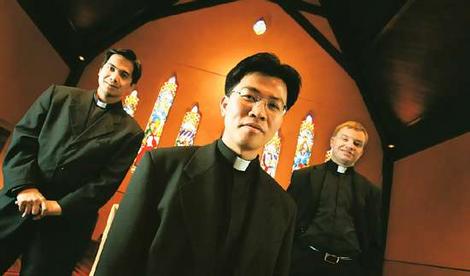
Poverty, chastity and obedience: it's an ascetic career path, and one fewer and fewer are choosing. Liz Porter meets some of the men who have traded a conventional life for the Catholic priesthood.
At 9.30pm on a Friday night, a group of young men cruise up and down Carlton's Lygon Street, revving car engines and chatting up girls. Two hundred metres away, in the historic bluestone chapel at the heart of Drummond Street's Corpus Christi Seminary, another group of young men kneel silently at evening prayer.
Read the whole article
Subscribe to:
Posts (Atom)

